Who actually sells ads in telegram mini apps?
Not Telegram. Most buyers get this part wrong.
The sponsored messages documentation Telegram publishes describes three placements and nothing else: a message under the last post of a public channel, an action bar above the chat in a bot, and a small text box over a fullscreen channel video. Mini Apps are not on that list. A Mini App, in Telegram's own developer guide, is a JavaScript web interface that a bot opens inside the client, so anything that runs inside one is code the app's developer chose to load. The only Mini App surface that page ties to the Ad Platform is the attachment menu, which it says is open to major advertisers on the Telegram Ad Platform.
In practice, telegram mini app advertising is a network business, and that leaves the ads in telegram mini apps to the networks. Each one ships a script or SDK, the app owner drops it in, and the network fills the slot from its own advertiser pool. When people search for a telegram mini app ads network, they are really looking for one of these companies, and each one sets its own formats, floors, moderation and payout rules. Nothing about them is standardised by Telegram, which is why the checks later in this guide matter more than any single rate.
The other half of the confusion is vocabulary. People use telegram paid ads, telegram app advertising and telegram mini ads for at least three different products: the official channel and bot placements, network ads inside Mini Apps, and plain paid posts bought from a channel admin. Before you compare prices, work out which of the three you are actually being sold.
The networks by name, and what each one publishes
These are market descriptions, not endorsements. We are not affiliated with any of them, and Telegram Solutions neither buys nor serves ads. Every figure below is the network's own, with where and when it published it. If a number is not here, we could not find the network publishing it.
RichAds
RichAds telegram ads are the best documented of the group. Its article comparing CPC and CPM in Telegram advertising, first published 25 September 2025 and shown as updated 9 October 2026, lists six Telegram formats across Mini Apps and bots. Push-style ads are billed per click from $0.015. Interstitial banners start at a $1.5 CPM, embedded banners at $0.4, playable and video at $3, and ads in bots at $3.8.
says $150 is the amount needed to get started. Those are floors, not what a campaign will clear, and RichAds itself lists higher recommended bids beside them. Treat the floor as the price at which your ads are allowed into the auction, nothing more. Check the page date before you budget against it.PropellerAds
PropellerAds telegram ads arrived with a press release dated 18 March 2025 announcing Mini App inventory. The release names a $100 minimum deposit and three pricing models, CPC, Smart CPC and CPA Goal, plus targeting by OS, browser, language and connection type. It publishes no Mini App rate card, so the bid you need comes from the dashboard, not from a page you can quote.
Monetag
The monetag telegram mini app offer is publisher-first. Its announcement introduced Rewarded Interstitials for Mini Apps: the owner registers the app's URL, creates an ad zone and pastes a JavaScript tag. It describes weekly payouts in USD and competitive CPM rates without stating a figure. No floor is given.
Inside Ads and Yandex
Searches for an inside ads telegram bot setup lead to a network that markets itself for Mini Apps and bots, but on 28 October 2026 we found no public rate card or publisher terms for it, which is itself the first check to run. Yandex telegram ads are a different thing: Yandex's 12 July 2023 announcement covers ads posted into Telegram channels with at least 2,000 subscribers by a Yandex bot, with advertisers paying per click through an auction. We found no Yandex SDK for Mini Apps.
Underneath the brand names, most of these behave as a telegram ad exchange: publisher slots on one side, advertiser bids on the other, and the network keeping the spread. The model itself is fine. What changes from one exchange to the next is how much of it the network is willing to put in writing.
How does CPM and telegram cpc pricing work on these networks?
It works the way it does on the open web, with Telegram adding nothing to the mechanics. Under CPM you pay for every thousand impressions the network counts. Under telegram cpc pricing you pay only when someone taps. Smart CPC and CPA variants move the risk further onto the network, which then filters your ads out of placements that do not convert, so your reach shrinks as your price per result improves.
Three things decide which one suits you.
the format: a rewarded interstitial is watched because the user wants the reward, so impressions are cheap to count and clicks are rarer than the view suggests. Second, the audience: a large share of Mini App traffic sits in tap-to-earn games, and a click from that crowd is worth less to most offers than a click from a utility app. Third, the measurement: an impression is whatever the network's script reports, and you have no Telegram-side counter to compare it with.The last point is the real difference from the official platform. On Telegram's Ad Platform the views are counted by Telegram. Inside a Mini App they are counted by the network that is also billing you. For the official side, our piece on what the official platform charges per thousand views covers it; this page does not repeat it.
So the cheapest CPM is not automatically the cheapest result. A network whose floor is a third of another's can still cost more per sign-up if its traffic is mostly reward hunters. Buy a small test on two networks, send each to its own tracked landing link, and compare cost per action rather than the rate on the pricing page.
What a mini app owner gets: the publisher side
Own the app, and the question flips. You are choosing who to sell your slots to. To monetize telegram mini app traffic with ads you add the network's script, pick formats such as rewarded video, interstitial or an embedded banner, and decide where in the app they appear. Most networks offer a reward callback so your server, not the browser, confirms that an ad was watched before granting anything. Use it. A reward granted from the client side is a reward anyone with developer tools can claim.
Ads-based telegram mini app monetization has to sit alongside Telegram's own rules. The Terms of Service for Mini Apps say nothing specific about third-party ads, but they make the app's developer responsible for the app, so a network that serves deceptive creatives is your problem, not the network's. Read its creative policy before you integrate, not after a user report.
Bot owners have a second, official route. Telegram bot ads appear as the action bar described in the sponsored messages docs, and Telegram's Ad Platform page states that 50% of ad revenue goes to the owners of the channels where ads are shown. That page names channels only, so do not plan a bot budget around a share it does not state. For a channel, the share follows ownership, which is one reason to know the seven-day wait before channel ownership moves before you sell or buy one that already earns.
The bot itself needs a name people can find. Ads that point at a bot handle depend on how Telegram's username search treats bot handles, and a handle that is hard to type loses clicks you already paid for.
Requirement, check, disqualifier
This is the table we would use before funding any network, as an advertiser or as an app owner. A row you cannot fill in is an answer in itself.
| Requirement | How to check it | Disqualifier |
|---|---|---|
| Published floor per format | A dated page or dashboard screen, per format | Rates only "on request" for self-serve |
| Minimum deposit | Stated before signup | Deposit revealed after KYC or a sales call |
| Who counts impressions | Ask how views and clicks are measured | No click IDs or postback support |
| Placement control | Blacklist and whitelist by app or bot | No way to exclude a placement |
| Creative policy | A written list of banned categories | None published, or "anything goes" |
| Publisher payout | Threshold, schedule and currency in writing | Payout terms changed without notice |
| Reward verification | Server-side callback for rewarded formats | Client-side reward only |
| Refund on unspent balance | Clause in the advertiser terms | Deposits non-refundable by default |
None of these rows is exotic. They are the questions any display buyer asks, applied to a market that is new enough that some networks still skip them. The deposit row matters most for small tests: $100 or $150 to try a network is reasonable, a deposit you cannot see until you have handed over documents is not.
Fraud sits behind the third row. In a tap-to-earn app, a script that reports an impression every time a user opens a reward screen can look healthy on a dashboard and send no one to your offer. Click IDs and a postback to your own tracker are the only way to see it, which is why we treat their absence as a disqualifier rather than a weakness.
Is a telegram ads bot free option worth anything?
Usually not, and the reason is structural rather than moral.
A telegram ads bot that promises free placement has to be paid by someone, and the usual answer is the people it posts to. Bots that swap shout-outs between channels, bots that post your link into groups, and bots that ask you to add their admin to your channel all trade your audience's attention for someone else's. Reddit threads collecting telegram ads reddit advice tend to land in the same place: free ad bots rarely send buyers, and the ones that post into groups get those groups reported. Posting the same link into many groups is the pattern Telegram's Terms of Service rule out as spam, and once enough people report it the sending account ends up asking what @SpamBot tells a restricted account.
So a free ad bot sits on the opposite side of paid placement. Paid ads are shown by the platform or the publisher with consent built into the slot. A free bot spreads your link through other people's chats, and the consent is missing.
Where telegram advertising software fits
In the sense people search for it, telegram advertising software is two different tools. One buys and manages ad slots. The other runs your own accounts and channels so that the reach is yours. Telegram Solutions is the second kind, and it is worth being exact about whether a marketing tool runs as a bot or as a user account, because those two follow different rules. Ours drives user sessions over MTProto, each tied to the api_id and api_hash a user client registers, and it buys no ad inventory anywhere.
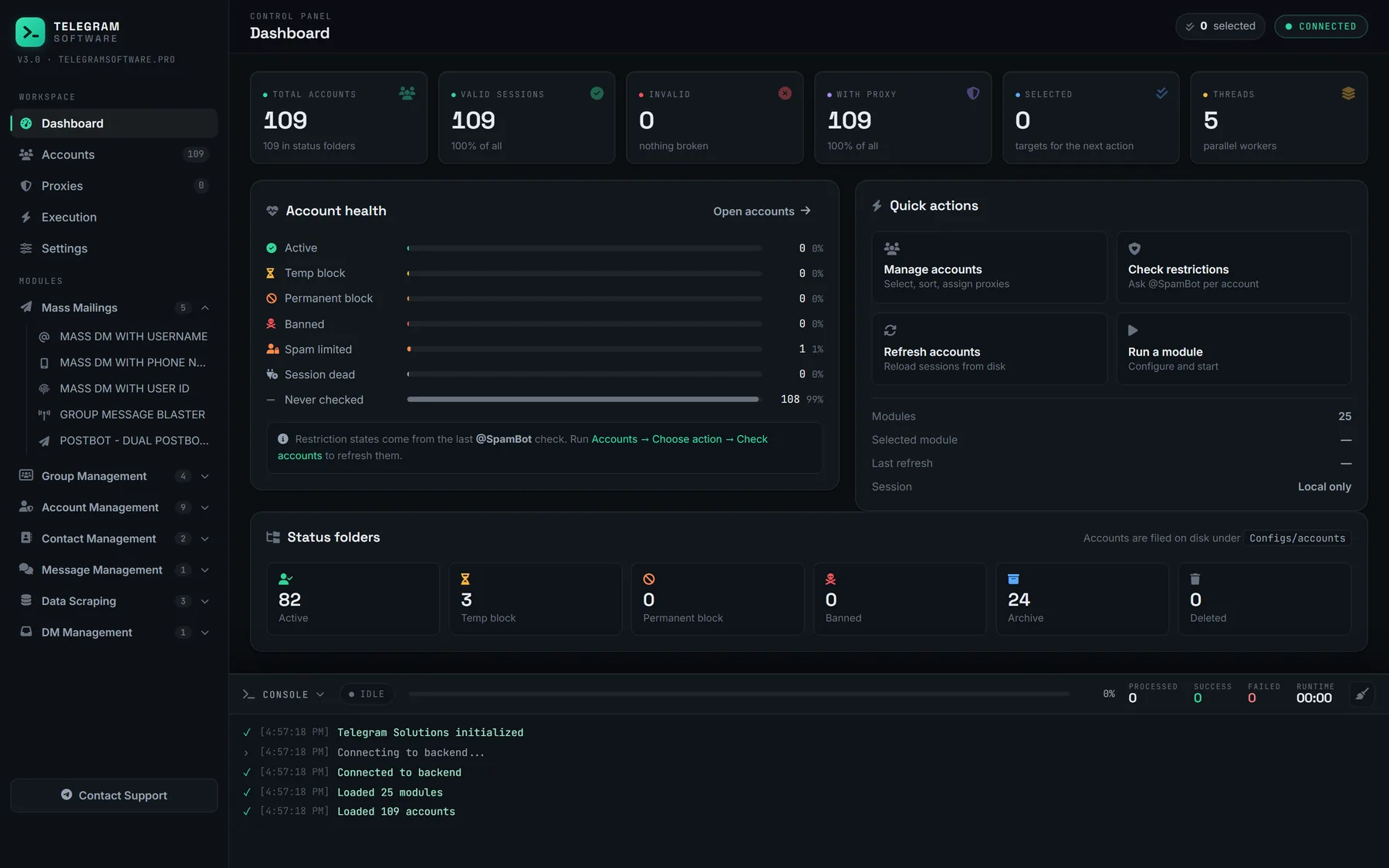
The dashboard above is what that looks like: account totals, session health and a live log. It is the other half of a campaign. Paid placement brings people to a channel or a bot; what keeps them is the channel you run afterwards. Teams that already pay for Mini App traffic tend to use the suite for the unglamorous jobs around that funnel: checking which of your sessions are still alive before a launch, how a phone number check decides whether a number is registered when a lead list arrives, and searching for public groups in your niche where a sponsored post could be bought from the admin rather than sprayed.
What it will not do matters as much. It does not place ads inside Mini Apps, it does not raise any of Telegram's limits, and it does not supply accounts or proxies. Should an ad network or a bot tell you a tool can make bulk posting invisible to Telegram, that claim is false, and it is a good reason to close the tab.
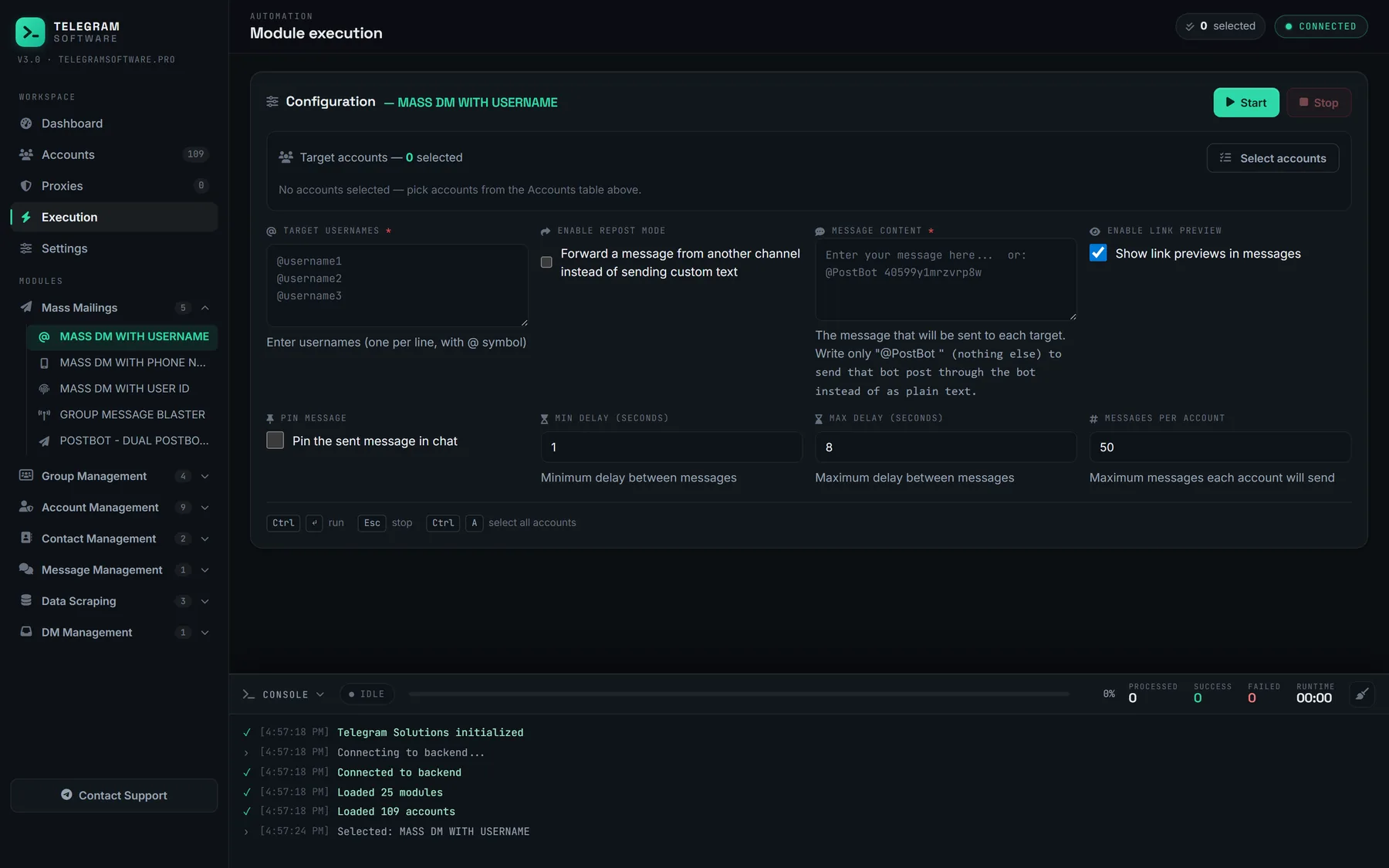
The module screen shows the other constraint: every account gets a per-account cap and a minimum delay, because limits live on Telegram's servers. A team using a group blaster that posts to groups rather than inboxes hits the same rules a free ad bot ignores, just with the pacing on display. Growing the group you send ad traffic to is a separate job with its own ceiling, set out in our note on adding members to a group past the 200 wall.
Where should the budget go in telegram ads 2026?
It depends on what you are selling and who counts the result.
For telegram ads 2026 the honest split is this. If your offer suits gamers and reward seekers, telegram mini apps advertising through a network with published floors is a sensible test, and RichAds and PropellerAds at least tell you the entry price. Where you need verified views and a brand-safe placement, the official platform counts them itself and reaches channels, bots and videos rather than Mini Apps. Buying a post directly from a channel admin is often both cheaper and better targeted than either when your audience lives in a few niche communities.
Whichever you choose, keep the receiving end clean. Ad clicks land on accounts and chats, and the small chores decide whether those clicks turn into conversations: saving a lead as a contact when a lead writes in, pruning a contact list so deleted entries stay gone after a campaign ends, and exiting every test group at once once a test account has finished its run. When a campaign closes, exporting chat history as a record keeps the replies you paid for, and clearing old message history in bulk resets a support account for the next one.
Our own product, Telegram Solutions, is a Windows suite for that receiving end: 25 modules sharing one session pool, $120/month, with the plans on our pricing page. It is not an ad network, and it does not replace one.