Reading the pages that rank for ways to find telegram groups to join in September 2026, we found several still sending readers to a Telegram menu removed in 2024, and almost none saying what the search bar matches. It matches names. A group without a public name has nothing to match, and every route outside the app is a list of links somebody chose to post.
Can I search for groups on Telegram?
Yes, if the group has a public name, and the match runs on two fields.
Type into the search bar and Telegram lists your own chats first, then everything public that fits under Global search: people, bots, groups and channels together. TDLib, Telegram's own client library, describes its public-chat search as matching the query against a chat's username and title, and among groups only supergroups can be public at all. So a telegram group search by name works when your words sit in the title, and a telegram group search by username works on the @name alone — how a name search lands on one holder covers the rules that name must pass.
Nothing else is matched: descriptions and conversations are not among those fields, so a search to find telegram group by keyword returns titles containing the word, never a room where it was merely said. Message search is narrower still, since the January 2025 update notes describe it as finding messages across your chats, meaning chats you are already in.
Results mix people with groups: a person's profile offers Add to Contacts and a group offers Join, the fork between saving a person the same search turns up and walking into a room. Numbers match nothing. A group's -100 identifier copied from an export is not a search term, and why a bare chat ID opens nothing is about access, which no spelling fixes.
When Telegram channel search doesn't work
A name you know that comes back empty is usually private, blocked on your platform, or no longer under that name.
First, privacy: a chat with no public username is never listed, as the next section explains. Second, platform. A chat can carry a restriction reason scoped to a platform identifier such as ios or android, and the app shows the server's notice instead, so one channel can open on a laptop and refuse on a phone. Content marked sensitive sits behind a separate filter, and the API tells each client whether it may change that setting at all. Third, the name: an exact @name that returns USERNAME_NOT_OCCUPIED belongs to nobody now, which is not the same as private or banned. Fourth, cleanup, since Telegram's Terms allow a channel running misleading giveaways to be scam-labelled and removed from search. Last, the connection. If the top of the chat list still reads Connecting, the app is not reaching Telegram at all, and a proxy that never gets past Connecting is a settings problem, not a search one.
Private groups have no name to search for
That is the whole reason they never appear.
Two kinds of address are kept apart in Telegram's link documentation. A t.me address followed by a username points at public users, groups and channels. An invite link, t.me/+ and a hash, or the older t.me/joinchat/ form Telegram still lists, is how people are invited into private groups and channels. A private group owns only the second kind, so no search has a name to hold, and trying to find private telegram groups means finding a person who will send the link, a member who adds you, or a shared folder link.
The link shows you something before you commit. Opening one returns a preview Telegram documents: title, description, photo, member count and a few of the people already inside. Two parts of it matter more than the count. The scam and fake flags mark a chat Telegram considers a likely scam, or one that many users have reported as a fake. The request flag means an admin approves each member, so tapping Join files a request instead of a membership, and INVITE_REQUEST_SENT is Telegram confirming it reached the admins — an invite link that files a join request, by design. INVITE_HASH_EXPIRED means the link died before you got there.
Reading a group before you join it
Public groups allow it; private ones mostly do not.
According to Telegram's FAQ, anybody can read a public group's entire history, and joining is needed only to post, so a group opened from search shows the chat with a Join button underneath. That is the plain answer to see telegram group without joining. A browser is the second route, at t.me/s/ plus the name. We tried that address on 22 September 2026: a public channel listed its posts, while a public group showed only its title, description and member count beside a button to open Telegram, which fits what a public channel shows to logged-out visitors. Telegram does not document that page, so treat it as observed behaviour.
A private group's preview stops at that card. The API does define a read-only look inside that expires, but does not say when a link offers it.
Joining is when the group can see you, and whether the members can see your number comes down to one privacy setting.
Where did Telegram's near me groups go?
They left with People Nearby.
Telegram added the feature in 2019, along with location-based group chats open to anyone close by. On 6 September 2024 Pavel Durov announced its removal, writing that fewer than 0.1% of users relied on it and that it “had issues with bots and scammers”. In its place he promised Businesses Nearby, a showcase for verified businesses with no room in it for groups. Any guide that still sends you to that menu is describing an app that no longer has it.
Traces remain in the API. The location methods are still documented with no deprecation notice, and the report reasons Telegram's API still lists include an irrelevant geogroup.
To find local telegram groups today, search for the town or district the way a title would spell it, because a local group can be found only when its public name carries the place. Past that the route is people: whoever runs the club, market or course can send the link or print its QR code.
Do search engines, directories and bots see more?
Different things, all of them posted by somebody.
The hunt gets typed as how do you find telegram groups, how to find telegram groups, find telegram groups online or find telegram groups reddit, and it gets sold as a telegram group search engine or a telegram group link search engine. Every version ends at a page where somebody pasted a link.
Web search engines see the t.me page of each public chat, plus every thread, directory entry and forum post carrying an address. A private group turns up only where someone pasted its invite link in public, and the page usually outlives the link. A directory is that crawl with a submission form on top; a Reddit thread is the same list with votes and no checks.
A telegram group search bot sounds like a window into Telegram's own index, and it cannot be one. The method behind global search is marked as callable by user accounts only, so a bot can answer only from a database somebody filled, by crawling, by submissions or with an ordinary account running out of sight, which is what a bot token can and cannot do applied to search.
One search does reach the words inside chats you never joined, and it stops at channels. The Posts tab Telegram added on 31 July 2025 returns results from public channels and opened to Premium users first. Groups are not part of it.
| Route | What it matches | Private groups | Why answers go stale |
|---|---|---|---|
| Global search in the app | A public chat's title or @username | Never | Groups rename or go private |
| Posts tab, since July 2025 | Words in public channel posts | Never; groups excluded | Channels only, by design |
| Web search engine | Public t.me pages and pasted links | Only a pasted invite link | Pages outlive revoked links |
| Directory site or search bot | Its own store of collected links | Only links it was given | Entries stay after the link dies |
| Reddit and forums | Links posted in threads | Sometimes, by pasted link | Threads age and links expire |
| People Nearby | Chats by location | Not applicable | Removed on 6 September 2024 |
The last column is where scam groups live, so read the preview's scam and fake flags before joining anything a stranger's list handed you.
From a list of found groups to joined ones
Whatever route found them, you carry away one of two handles: a public @name or a t.me link, invite links included. The source field on our Member Scraper, below, asks for exactly that.
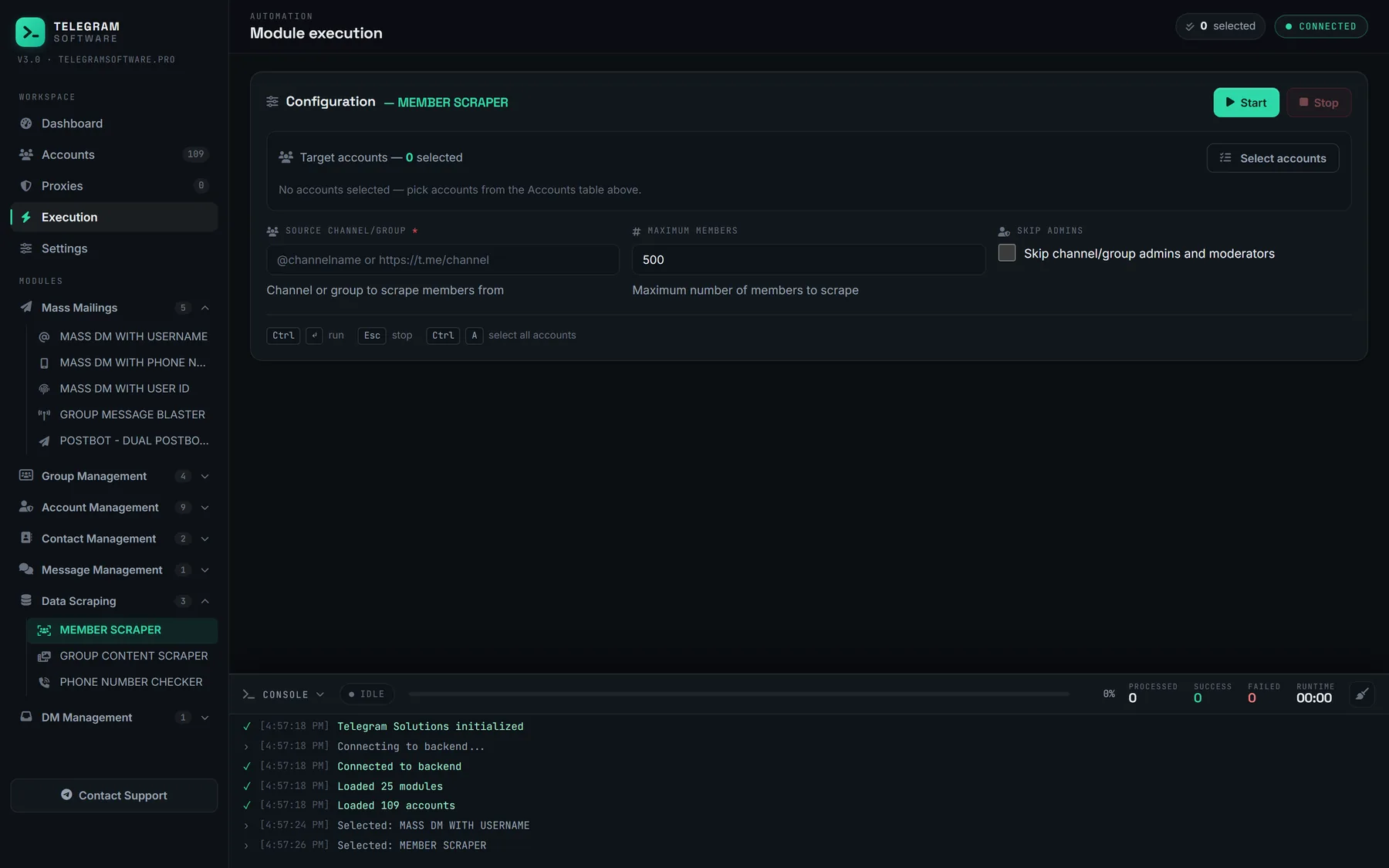
In our panel the list goes to Join Groups / Channels, which spreads the joins across the sessions you select, and the same list can feed the Group Message Blaster, where what the accounts meet once they are inside takes over. Each account stops at a ceiling Telegram sets, a maximum of channels and supergroups the server hands the client, and past it a join returns CHANNELS_TOO_MUCH. Once a campaign ends, Leave Groups / Channels undoes it, and because joining saves no contacts, clearing the address books other runs fill is a separate job.
Joining a room is the opposite job to moving people into a group you run. A member list read out of a joined group is personal data, and messaging those people is direct marketing under GDPR, CAN-SPAM and their equivalents, so the lawful basis has to be yours.
None of this finds a private group, reads a chat no session in the pool can see, or lifts the join ceiling, and we supply no accounts or proxies. Telegram's spam FAQ says username search is not a way to make new friends, asks you to contact only people who expect to hear from you, and says the same about adding people to groups they did not want. Its Terms of Service rule out spam and scams. A room full of strangers is the case both were written about.