What does a telegram blaster actually blast?
Groups and channels the account is already sitting in.
That is the whole distinction, and the listings blur it. A telegram blaster reaches chat windows other people are standing in too, so every target has to be joined first. A bulk DM tool reaches private inboxes, where the pool refuses for different reasons. Reach is not bought with speed. It is bought with membership.
The category wears a lot of names. Telegram blasting, telegram blast messages, a telegram blast group tool, telegram blaster software, or plainly a telegram blast bot — one pitch under all of them: paste a list of chats, paste one message, walk away. Another two fill in as you type, telegram blaster pro and teleblaster pro, which are product names rather than descriptions.
Underneath the naming sit two architectures. Telegram's bot introduction says a user must add a bot to a group before it can act there, and the Bot API has no method for joining one. So anything that walks itself into two hundred chats is a logged-in account on MTProto, and every refusal belongs to a person.
A telegram auto joiner runs into a ceiling, not a speed limit
The ceiling is a number Telegram hands your client at login, and no delay setting moves it.
The client configuration reference documents a field called channels_limit_default, described as the maximum number of channels and supergroups a non-Premium user may join, with a separate value for Premium. That value arrives at runtime rather than being printed as a documented constant, which is worth saying plainly: the figures traded around this category are read out of a sample config dump, and Telegram can change them without announcing it. The wall itself is documented. Past it, channels.joinChannel answers CHANNELS_TOO_MUCH, which Telegram glosses as having joined too many channels and supergroups, and it will answer the same thing tomorrow.
A telegram group joiner is therefore a capacity tool before it is a speed tool. An eight-hundred-chat blast list cannot exist on one account at any pace, and the only lever that genuinely helps is leaving the chats a campaign has finished with. Joining and leaving ship as one job here for that reason.
Two routes go in, and they fail differently. A public chat with a username, the kind a Telegram group search can surface, is joined outright. A private one needs an invite hash and goes through messages.importChatInvite, where INVITE_HASH_EXPIRED means the link died before you reached it, and INVITE_REQUEST_SENT is not a failure at all. It means an admin now holds an application, and the run should stop treating that chat as a live target until somebody approves it.
Naming sprawls here as well. A telegram auto joiner, a bulk joiner, a script pulled off a public repository: one call, three wrappers. The difference that matters is whether the wrapper can tell a chat it cannot join yet from one it will never join, because retrying the second kind is how an account spends its allowance on nothing.
All of that is the mirror image of bringing people into a group of your own, and the two hit unrelated walls. One is capped by how many rooms you can stand in. The other is capped by who is willing to be moved.
Why does a blast stop in a group you already joined?
Because the chat refused it, and speed had nothing to do with most of these.
The error list on Telegram's send method reads as permissions rather than penalties. CHAT_WRITE_FORBIDDEN is documented as not being able to write in that chat, which is what an announcement-only channel returns to everybody who is not an admin. CHAT_SEND_PLAIN_FORBIDDEN is narrower and stranger, naming text messages specifically. CHAT_RESTRICTED and USER_BANNED_IN_CHANNEL both mean a moderator already decided something about that account. None of the four changes if you wait.
Slow mode is the one people misread most often. It is a group setting rather than a Telegram penalty: SLOWMODE_WAIT carries the seconds to wait before sending in that chat again, and an admin turned it on. A blast list where a third of the rooms run slow mode takes hours whatever the software does. That is arithmetic, not a fault.
Two more failures are account-level, and they are not the same event. FLOOD_WAIT carries a number of seconds and belongs to the method just called. PEER_FLOOD carries no number and belongs to the account. Telegram publishes the first in its error reference and does not publish the second anywhere, so the meaning operators rely on comes from client libraries, and we mark it observed rather than repeat it as policy. Unsolicited posts are also what make a room's members press report, and the complaint lands on the account rather than the software.
| What comes back | Who set it | What clears it |
|---|---|---|
| CHAT_WRITE_FORBIDDEN | The chat's own posting rules | Posting rights in that chat, or nothing |
| CHAT_SEND_PLAIN_FORBIDDEN | The chat's own posting rules | Nothing you can set; it names text |
| CHAT_RESTRICTED | A moderator in that room | Their decision, not your pacing |
| USER_BANNED_IN_CHANNEL | A moderator in that room | An unban |
| SLOWMODE_WAIT | The group's admin | Waiting the stated seconds |
| FLOOD_WAIT | Telegram, against one method | Waiting the stated seconds |
| PEER_FLOOD · observed | Telegram, against the whole account | Time, and @SpamBot holds the record |
The row marked observed is not in Telegram's published error table for this method.
Forward mode inherits a refusal that text mode never meets. A source chat with content protection switched on answers CHAT_FORWARDS_RESTRICTED, and nothing on our side changes that — it is the same wall a forwarding setup meets from the other direction.
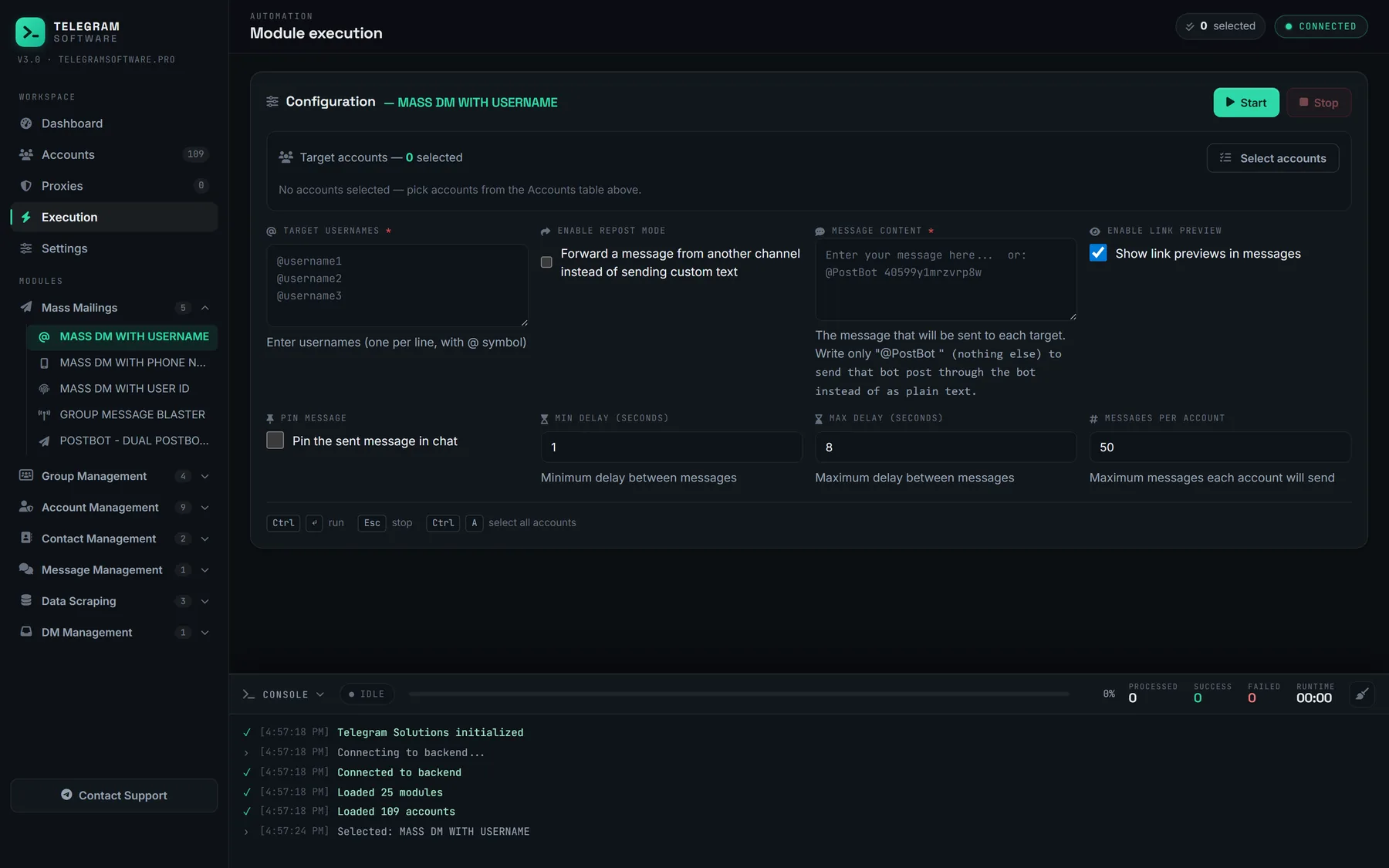
The panel controls the part that genuinely belongs to you. Repost mode decides whether a run sends fresh text or forwards an existing post. Min delay and Max delay randomise the interval instead of firing on a metronome, and the per-account cap decides how much of the list one session carries. In the build shipping in August 2026 the Group Message Blaster reads a wait, holds that session, and continues on the others rather than retrying into the same error.
The one thing a telegram blaster crack actually wants
Your logins. Nothing else in this category is worth stealing.
A search for a telegram blaster crack or a telegram blaster free download lands on keygen sites, and whatever comes back is software you then hand session files or a TDATA folder to. Those are not preference files. A session is a live credential for a phone number, and an unauditable build is holding every one you own.
The credential underneath carries rules of its own. Telegram's API credentials page states that each number can only have one api_id connected to it, that accounts signing in through unofficial clients are automatically put under observation, and that using the API for flooding or spamming gets the account banned forever. A cracked build ships somebody else's api_id by definition. We would rather sell you a licence with support behind it.
Where a blast run ends, and what we will not claim for it
The list is short, and being blunt about it costs us nothing that was ever real.
This software raises no Telegram limit. Those limits live on Telegram's servers and apply to every client that speaks the protocol, ours included. It does not supply accounts or proxies, it cannot make a read-only channel writable, and it cannot argue a moderator's restriction into reversing itself.
The boundary is written down in two places. Telegram's Terms of Service ask you to agree not to send spam or scam users, and the spam FAQ asks you to only contact people if you are sure they are expecting messages from you. A room full of strangers is the exact case both were written about, and spreading one message across more rooms changes nothing about what the people in them receive.