Most comparisons line the two apps up feature by feature: file size, stickers, themes, call quality. That list changes every few months. This one starts from the two decisions underneath, where messages are stored and what an account is, and follows them out to groups, channels, bots and the business side. Signal, iMessage, Session and Threema get one compact section on the privacy axis near the end.
Which app encrypts more of your messages by default?
WhatsApp does. Every personal chat and call on WhatsApp is end-to-end encrypted by default with the Signal protocol, so the keys sit on the participants' phones and WhatsApp relays ciphertext it cannot read; the company explains this on its end-to-end encryption help page. Telegram made the opposite trade. Its FAQ says ordinary cloud chats are encrypted between your device and Telegram's servers, and only Secret Chats are encrypted end to end.
That decision explains most of the feature gap. Because Telegram holds a readable copy of a cloud chat, the same conversation opens on a phone, a laptop and a browser at once, a 200,000-member group can show its full history to someone who joined yesterday, and a bot or a desktop client can search everything you can see. Secret Chats give all of that up. They live on two devices, work only one to one, and never sync to a third. Groups and channels have no end-to-end option at all.
The honest answer on telegram vs whatsapp privacy is split. On message content, WhatsApp's default is stronger, because there is no setting to forget. Identity exposure runs the other way, which the next section covers. In practice, for telegram vs whatsapp security, the failures people actually suffer on both apps sit outside the cryptography: a hijacked SIM, an unlocked phone, a linked device someone else added, a backup stored somewhere less protected than the chat.
Cloud storage cuts both ways for a business. A server-side history means a support team can work from several machines, and one employee's lost phone does not erase the record. It also means history only disappears when someone removes it on purpose, and wiping your own message history on Telegram is a chat-by-chat job rather than one switch. When you need a record instead, Telegram Desktop can export a chat to HTML or JSON, while WhatsApp's per-chat export gives a plain text file with optional media.
Does a phone number still have to be your identity?
On WhatsApp, for now, mostly yes. A WhatsApp account is a phone number, and in a shared group the other members have been able to see it. Meta opened username reservations at the end of June 2026 and is switching usernames on country by country through the rest of the year.
Telegram separated the two long ago. You still need a number to register, but a public username lets people find and message you without it, and a privacy key decides who may see the number at all. With several accounts, set phone-number visibility and the other privacy keys on all of them first. Adding a contact by username, number or QR code never requires exchanging digits, and once a phone has uploaded its address book, removing synced contacts so they stay gone takes more than one tap.
For a business, identity decides who can reach you. A WhatsApp presence is anchored to a number customers save; a Telegram presence to a @username or link that can sit on a website or a printed QR code, and an agent answering in a public group shows a name, not a personal mobile number.
How large can a Telegram group vs WhatsApp group get?
The cap is 200,000 members on Telegram and 1,024 on WhatsApp.
Both figures are official: Telegram's FAQ gives the 200,000 figure, and WhatsApp set its cap at 1,024 users when it launched Communities in November 2022. A WhatsApp Community links several groups under one announcement group for audiences above the cap, but each group inside it still holds at most 1,024 people.
The size gap also changes how people arrive. A public Telegram group has a username, so strangers find it by searching public groups by name; WhatsApp has no public group directory, and you join by invite link or because an admin added you. Here an invite link is not the same as adding someone: privacy settings block many direct adds, while a link lets the person decide. Admins who try filling a group past the first 200 members by adding them run into exactly that wall. Members collect groups fast too, and quitting every group at once is a routine Telegram clean-up. The whatsapp group vs telegram group choice is a private room versus a public space that scales.
Telegram channel vs WhatsApp channel
Both apps now have one-way broadcast feeds, but they are different products. A Telegram channel has no subscriber cap, a public username, a full archive that new subscribers can scroll back through, comments through a linked discussion group, and admin rights you can pass on; passing channel ownership to another admin is built in, behind a security check. WhatsApp Channels, launched in 2023, sit in a separate Updates tab, hide the admin's phone number from followers and keep updates on WhatsApp's servers for a limited time rather than as a permanent archive. The telegram channel vs whatsapp channel decision therefore turns on discovery and archive. A Telegram channel is a public page with a back catalogue that readers search, link and even copy a channel's media archive from; a WhatsApp channel is a notification stream inside an app most of your customers already open every day. Many brands run both and treat the WhatsApp side as the alert and the Telegram side as the library.
Can a bot or an API run the business side?
Yes: free on Telegram, paid per message on WhatsApp.
Telegram's Bot Platform is free for users and developers, and a bot needs no phone number to set up. One rule shapes everything built on it: bots cannot start conversations, so a user has to message the bot or add it to a group first. A bot that relays content only works in chats it was added to, the whole story of a bot that relays posts between chats. Bots that claim to add members run into the same server-side rules as people, and the limits on member-adding bots are not something a bot can lift. Apps that act as a full user account rather than a bot use MTProto and need registering an api_id and api_hash first, a separate surface with separate rules. On top of that, Telegram Business, added in March 2024 for Premium subscribers, gives a personal account opening hours, a map location, quick replies, greeting and away messages, chat links and a connected chatbot that answers on your behalf.
WhatsApp splits the same job in two. The free WhatsApp Business app runs on one phone with labels, a catalogue and automatic greeting and away replies. Anything automated at volume goes through the WhatsApp Business Platform, whose Cloud API is hosted by Meta. According to Meta's pricing documentation, conversation-based pricing was replaced by per-message pricing on 1 July 2025. A business may message a customer freely only inside a 24-hour customer service window that opens when the customer writes; outside it, only pre-approved template messages in the marketing, utility or authentication categories can be sent, each charged by category and country. From 1 October 2026 Meta also resumed charging for service replies, with a free tier of 1,000 delivered service messages per business number per month. In the telegram bot vs whatsapp bot comparison, neither lets you speak first to a stranger: Telegram forbids it outright, and WhatsApp allows it only through a paid template to someone who opted in.
That cost structure is where telegram vs whatsapp for business usually gets decided. A business whose customers already live on WhatsApp pays for reach that is hard to match anywhere else. A business that wants a free bot, a public channel and community groups of thousands gets those on Telegram without a per-message bill, and broadcast work there looks more like posting the same message across many groups than paying for templates.
Where do Signal, iMessage, Session and Threema fit?
All four sit closer to WhatsApp than to Telegram on privacy, and two of them go further.
Signal is the app whose protocol WhatsApp adopted, with end-to-end encryption for every chat and group by default and far less metadata kept; in a signal private messenger vs telegram comparison, Signal wins on privacy and loses on public groups, channels and bots, which it barely has. As for telegram vs iMessage, that is a platform question first: iMessage encrypts end to end but only between Apple devices, so it cannot be a business channel for anyone whose customers use Android. Session vs Telegram is the furthest apart. Session needs no phone number or email, gives each account a random Session ID and routes messages through a decentralised network, at the cost of the polish and the reach that Telegram has. Threema vs Telegram is similar: Threema assigns a random Threema ID, makes linking a number or email optional and charges once for the app. None of the four has anything like Telegram's open bot platform or 200,000-member groups.
So which is better, Telegram or WhatsApp, for a business?
It depends on where your customers already are, and the table shows why.
| Design point | Telegram | |
|---|---|---|
| Default chat encryption | Client-server; end to end only in Secret Chats | End to end for all personal chats |
| Identity | Phone number plus optional public username | Phone number; usernames rolling out in 2026 |
| Largest group | 200,000 members | 1,024 members per group |
| Broadcast | Channels, no subscriber cap, permanent archive | Channels in the Updates tab |
| Automation | Free Bot API; bots cannot message first | Cloud API; paid templates outside 24 hours |
| Multi-device history | Full cloud history on every device | Linked devices, history stored on the phone |
Both figures on telegram vs whatsapp users are self-reported and defined differently. Mark Zuckerberg told investors on Meta's April 2025 earnings call that WhatsApp had passed 3 billion monthly users, and Telegram's FAQ says it has over 1 billion active users. Neither number tells you where your own customers spend time. Ask them.
People type the same question a dozen ways, whatsapp vs telegram, wa vs telegram, telegram vs whatsapp features, telegram vs whatsapp business, whatsapp business vs telegram, and the answer splits the same way every time: WhatsApp for one-to-one customer service with people who already have your number, Telegram for anything public, large or automated. There is no single winner in telegram vs whatsapp which is better, only a right tool for each half of the job, and plenty of brands run both. In a whatsapp bot vs telegram bot decision specifically, Telegram is cheaper to build on and WhatsApp is closer to the customer's inbox. The same split holds for the whatsapp channel vs telegram channel choice.
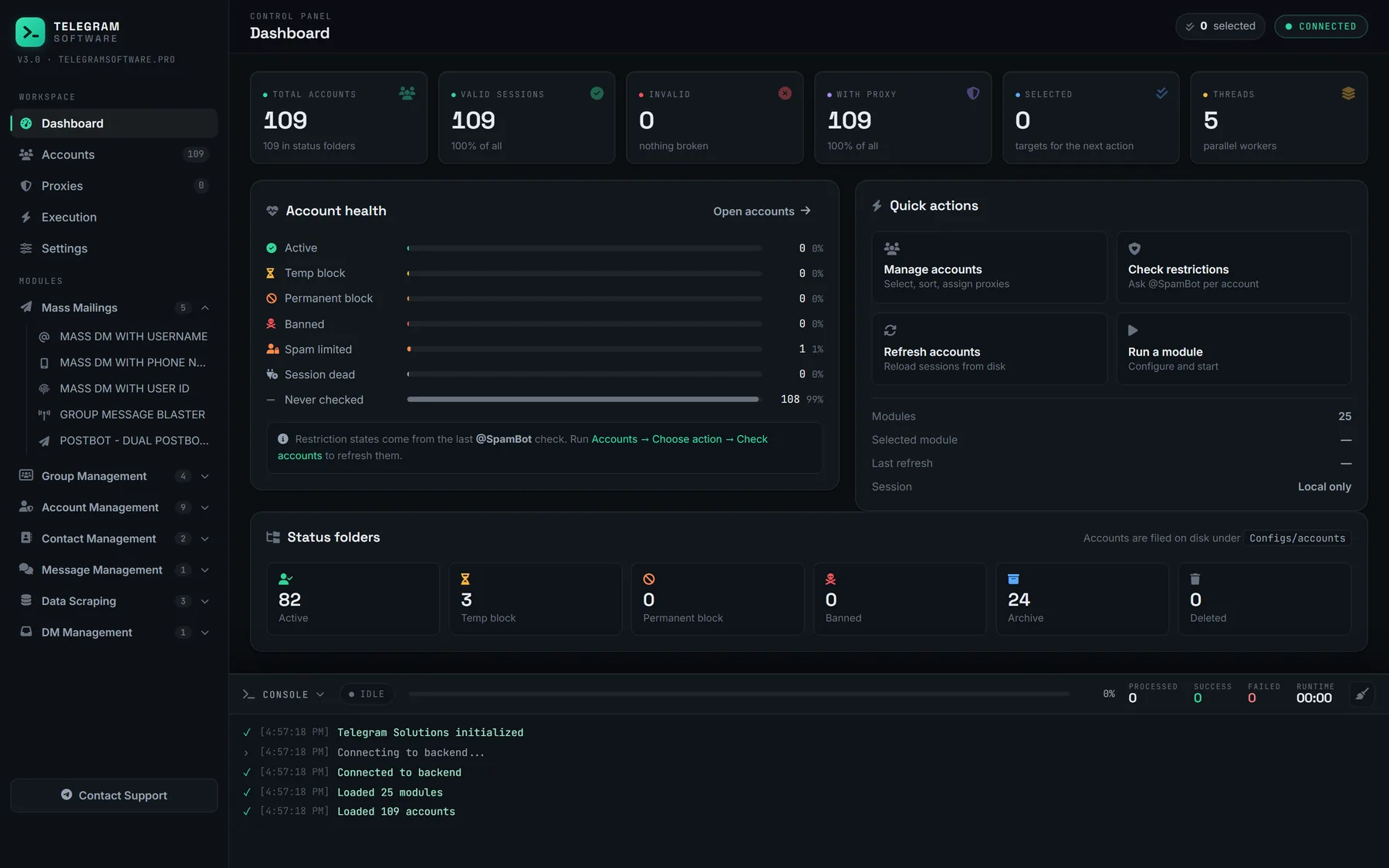
If the Telegram half of your operation means many accounts, groups and channels, that is the part our panel handles. Our panel works only on Telegram. It does not touch WhatsApp, it does not raise any of Telegram's limits, and it does not supply accounts or proxies; you bring your own. Telegram's Terms of Service forbid spam, and unsolicited bulk messages are what Telegram's PEER_FLOOD restriction exists to stop, so the people on the receiving end of any outreach decide whether it works.