The tool is sold under a dozen names. A telegram active users scraper, a telegram active users extractor, a telegram active members scraper, a telegram active member extractor, a telegram engagement scraper: the label changes and the job does not, which is to scrape active Telegram users rather than everyone who once pressed Join. All of them read the same three things Telegram shows about a person's activity, and none of them can see who reads in silence. A Bot API bot cannot page back through a group's history at all, so this is user-session work, which is exactly where chatbot-style marketing software and the account-based kind part ways. The difference shows in the file: a list of people who posted this week is far shorter than the member count, and every row on it belongs to someone who was actually there.
Why does the member list miss the people who talk?
Because it was never a list of who talks.
A member list records who joined, and it stops short in three ways. In Telegram's own TDLib library, participants come back up to 200 per request, and operators routinely report that paging stops near 10,000 members however large the group is; Telegram has never published that figure, so treat it as observed. Since December 2022, admins of groups with 100 or more members can hide the list completely, and a broadcast channel's subscribers were only ever visible to its admins. What a member-list scraper can actually read covers those ceilings in detail. Messages are different. Every message in a supergroup carries its sender, so anyone who writes stays visible in the chat even when the list is hidden. The list that comes out is shorter, which matters once it goes anywhere near the limits a member add bot really runs into.
Three signals Telegram shows about activity
There are exactly three, and each one catches a different person. Recent posters come out of a group's message history, commenters come out of the reply thread under each channel post, and last-seen status comes from the profile. A telegram scraper active members only setting is a filter over those three, not a fourth source. Each of them exports in the same shape, a numeric ID with a username where one exists, and the gap between a user ID and a chat ID starts to matter once the list moves into another module.
| Signal | Where Telegram keeps it | Who it catches | Who it misses |
|---|---|---|---|
| Recent posters | Group message history | Members who wrote inside the window | Silent readers, anonymous admins |
| Channel comments | The linked discussion group | People who replied under posts | Channels with no linked group |
| Last seen | User status on the profile | People who opened Telegram lately | Anyone who hides it from you |
| Member list | The participant list | Everyone who joined, active or not | Hidden lists, channels you do not run |
Recent posters come out of message history
Reading history is slow, and it is meant to be. Telegram hands back a chat's messages in pages, typically up to 100 per request according to its own notes on paging and offsets, and a scraper walks backwards from the newest message until it reaches the oldest date in its window. A seven-day window on a busy group is a handful of pages. A year of the same group is thousands of them, and every page is one more request from the reading account.
Each message names a sender, but not always a person. In Telegram's message object the sender field is optional: an anonymous admin's messages are signed with the group's name, a post sent as a channel points at that channel instead of an account, and the copy of each channel post that lands in a discussion group arrives from the channel itself. None of those is a user you could ever message. Deleted accounts also stay in history, shown as Deleted Account with an ID and nothing else, and bots post as well. A clean telegram scrape recent posters run drops all four before it counts anyone.
The ID is the part worth keeping. A username can be changed, or released and then claimed by somebody else, so a list keyed on usernames slowly drifts toward the wrong people, while the numeric ID stays with the account for its whole life. Store both, match on the ID, and treat the username as a label that was true on the day of the scrape.
Two settings decide how far back an account can see. If a group hides its history from new members, an account that joins today reads only what was posted after it joined, so joining to read last month's messages gets nothing. A private group answers CHANNEL_PRIVATE to any account that is not a member. Public groups are the ones worth finding by name through Telegram's search, and an account that joined a few dozen of them for one scrape should leave those groups in a single pass afterwards rather than keep collecting them.
For one chat, once, no scraper is needed. Telegram Desktop will export that chat's history as JSON, and every message in the file carries its sender's ID. The case for a tool starts with the second group, then the tenth and the fiftieth, de-duplicated into one list, and searches such as telegram scrape engaged users or telegram scrape active members are describing exactly that job.
How does a telegram channel comments scraper reach commenters?
Through the discussion group, never through the channel itself. Telegram's documentation on discussion groups defines a post's comment section as the reply thread of that post's automatic copy inside the channel's linked supergroup, so a channel with no linked group has no comments at all. Where the thread exists, a telegram comment scraper reads it reply by reply and keeps each author. Replies to replies sit in the same thread, so one pass collects the whole conversation under a post, not just its first layer. That is the whole of what a telegram comment scraper tool does, and all that a telegram scrape commenters search is really asking for. Commenting does not require joining the discussion group, so commenters are often people who never appear in its member list. For a broadcast channel you do not run, they are the only audience you can see at all, because the subscriber list belongs to the channel's admins, the same short list a channel ownership transfer hands over.
What does "last seen recently" mean to a scraper?
It means the user hides the exact time from you, and the real one falls somewhere between a second and two or three days ago. The buckets are set out in Telegram's FAQ on last seen. Recently covers anything from one second to two or three days, within a week runs from two or three days to seven, within a month from six or seven days to a month, and a long time ago is anything older, which is also what blocked users always see. So a telegram last seen recently scraper is not reading a timestamp. It reads a bucket.
Two things follow from that. A user who hides last seen has to be matched by message activity instead, which is why the status filter and the posters filter belong together rather than as alternatives. And the reading account's own privacy changes what it gets back: Telegram has withheld exact times from people who hide their own since 2014, and since January 2024 only a Premium account can hide its own time and still see other people's. The API reports that case as recently, with a flag meaning the exact status is hidden because of your own settings. That makes the reading accounts worth setting up on purpose, and running several accounts in one app is where that begins. Privacy settings shape the number field the same way, as anyone looking someone up by phone number soon finds out.
Online status is narrower again. It shows only for people whose settings let you see it, and it carries an expiry time rather than a promise, so a telegram scraper online users filter is a snapshot of whoever shares their status, taken at the moment of the scan. A telegram active users tool that claims to show who is online across a 50,000-member group is sampling those few people at one moment. Useful, but not a census.
Running the Activity Scraper, and where it stops
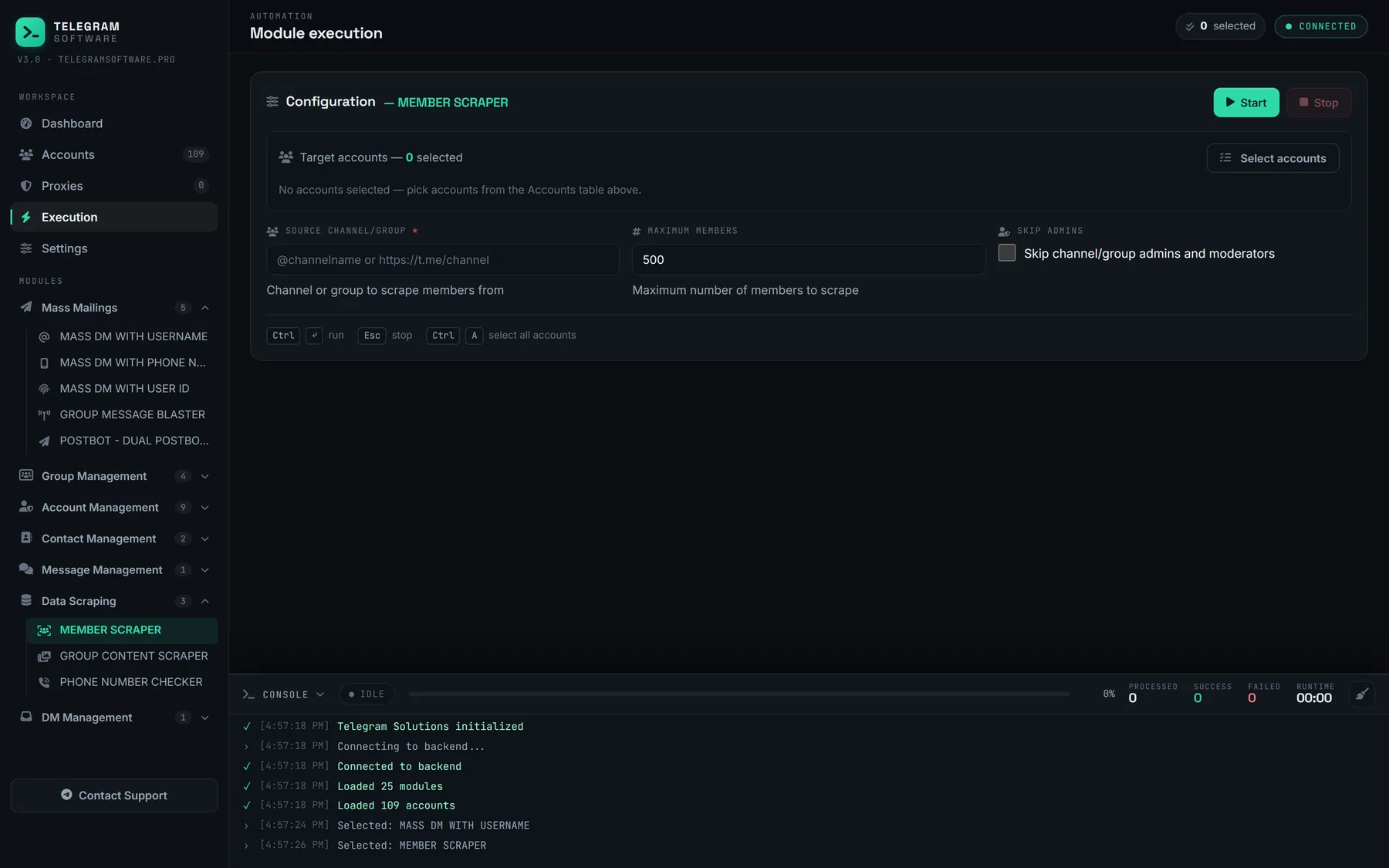
In Telegram Solutions this work sits in the Activity Scraper, the messages-and-comments module, which reads through the same session pool and pacing engine as every other module. A run goes in this order:
- Pick the reading accounts from the pool, each one a session you brought on its own number with its own API ID.
- Paste the source: a public @group_name, a t.me link, or a channel whose comments you want.
- Choose what counts as active: posted within a set number of days, commented under recent posts, last seen within a bucket, or a combination.
- Drop bots and admins from the result.
- Export IDs and usernames, or pass the list straight to Member Add or Mass DM.
The walkthrough below shows a full run, from choosing the source group to the finished export.
The source matters more than any setting. A group of a few thousand where people argue every day yields a longer active list than a silent group ten times its size, and a channel whose posts each collect a dozen replies beats one with comments switched on and nobody using them. Before a run we open the source in the ordinary app and scroll back a week, because if that week shows the same three names, so will the export.
Reads are paced, not raced. Telegram publishes no threshold for history requests, and an account that asks too fast receives FLOOD_WAIT_X, which its error reference defines as a wait of X seconds before the call will work again. We built the pacing engine to back off when one arrives instead of retrying into it. It does not make the wait any shorter, and nothing could. Sessions load as Session + JSON files or as TDATA folders, including the tdata a portable Telegram copy keeps beside its exe, and they never leave the machine the panel runs on.
A list of active people still has to be reached by a route Telegram allows. Where someone's privacy settings refuse a direct add, the API answers USER_PRIVACY_RESTRICTED and an invite link instead of a direct add is the route left, and saving someone as a contact only makes sense where they would expect it. Contacts imported for a single campaign are worth clearing out of the account afterwards.
What the module will not do is short. It cannot see readers who never post, comment or share their status, it does not raise Telegram's limits, and it does not supply accounts or proxies. Telegram's Terms of Service state that it prohibits data scraping, and the content licensing terms they point to allow access to user content only for ordinary, legitimate and intended use, so a scraping account carries that risk whichever tool drives it. The list itself is personal data, too. Messaging the people on it is direct marketing under GDPR, CAN-SPAM and their equivalents, and that needs a lawful basis the software cannot give you.