Saving a number and writing to it feel like one act, because that is how a phone's own messaging app works. On Telegram they are two, and the second does not need the first. The number is an address Telegram's servers look up, and the lookup answers to the other person's privacy settings, not to your address book.
Search engines see the same wish typed six ways — send telegram message without saving number, how to send telegram message without saving number, how to send message without saving number in telegram, message on telegram without saving number, a telegram chat without saving number, how to text someone on telegram without saving their number — and every version blames the contact list. The contact list was never the gate; the owner's settings are.
How to message someone on Telegram without saving their number
Turn the number into a link. A Telegram message without saving number starts there, and nothing is stored at any step.
- Write
t.me/+followed by the number in international format, country code first. - Open it in a browser on a device where Telegram is signed in, or paste it into any chat, Saved Messages being the usual one, and tap it there.
- If the owner can be matched, the chat opens. Write and send.
The behaviour is documented. Telegram's deep-link reference lists the phone link beside usernames and invites, resolved through contacts.resolvePhone, which answers to the same privacy setting a saved number does. It also takes an optional ?text= parameter that pre-fills the message box whenever you are allowed to write in that chat, and a profile flag that opens the profile instead. The iPhone app prints a link of this shape for your own number on the Phone Number privacy screen, captioned as a public link that opens a chat with you.
For anyone already within reach, the ordinary answer to how to message someone on Telegram is the compose button on the chat list: pick a contact or type a name into search, then write. That also covers how to text someone on Telegram. There is no separate SMS mode, and a number that is not registered gets an invitation instead of a message.
Why does a t.me/+ link open nothing?
Because the owner chose that.
Under Settings → Privacy and Security → Phone Number, in the layout Telegram introduced in 2019, a second switch appears once Who can see my phone number is set to Nobody: Who can find me by my number, with two values, Everybody and My Contacts. On My Contacts, only people the owner has saved can match the number to the account. Saving it on your side would not have helped, because a contact import is checked against the same setting. So the answer to can we send message in telegram without adding contact is yes when the owner allows a match, and when they do not, adding the contact changes nothing at all.
A hidden number and an unregistered one also look alike from outside. Telegram documents one error for this lookup, PHONE_NOT_OCCUPIED, for a number with no account behind it, and says nothing about hidden ones, which is why a phone lookup so often comes back empty. The same privacy screen holds the switch behind the privacy refusal a group add runs into.
How to message someone on Telegram by username, or from a group you share
No number is needed on either side.
A public username is an address built for strangers. Search it, or open t.me/ followed by the name, and the profile opens ready to write; Telegram's own FAQ says people who find you that way can message you "even if they don't know your number". That is the whole answer to how to message someone on Telegram by username. When a handle returns nothing, the cause is usually one of the two errors behind an empty username result, a typo or a name its holder has since dropped.
A shared group works as well. Tap the person's name in the member list or on one of their messages, open the profile and start the chat, which is how to message someone on Telegram without adding them when you hold neither a number nor a username. Admins can hide a member list, though, and a group you have not joined turns up in search only if it has a public name that search can match.
Every telegram send message without contact route ends the same way: with a chat, not a contact. The chat sits in your list under their profile name, and if you want them saved later, saving them by username or QR code still needs no number. People who saved a number just to write once can delete it afterwards and keep the chat, but a phone that still syncs contacts can put the deleted name straight back, and anyone who wants a record first can take a copy of the conversation from Telegram Desktop.
Found the profile, but the message will not go?
Then a message setting is in the way. In January 2024 Telegram let people restrict new chats to My Contacts and Premium Users under Who can send me messages, so a stranger without Premium is told that only Premium users can message them, and the API returns PRIVACY_PREMIUM_REQUIRED. Since March 2025, Premium users can also charge a fee in Stars on each message from outside their contacts, added in Telegram's Star Messages update. Both gates wave through the owner's contacts and anyone the owner wrote to first.
| What you see | What it means | What moves it |
|---|---|---|
| The number link opens no one | Hidden from strangers, or never registered | Only them: a username, a link or a first message |
| Only Premium users can message them | New chats limited to contacts and Premium | Premium, or their message first |
| A Stars price per message | The owner charges people outside their contacts | Paying the fee, or another route |
| Replies send, new chats fail | Your own account is limited after spam reports | Ask @SpamBot and wait it out |
Can a Telegram bot send a message to a phone number?
No.
The developer's version of this search, telegram bot send message to phone number, ends at one parameter. The Bot API's sendMessage takes a chat_id that is either a numeric ID or the @username of a supergroup or channel, and there is no field for a number. Telegram's bot documentation adds the second wall: bots can't start conversations, so a person has to message the bot or add it to a group first. A bot learns someone's number only when that person chooses to share it, usually by tapping a button the bot offers. We covered why a bot never gets to write first at length, and it comes down to a bot token against a signed-in account; even a numeric ID is only half the address a chat needs.
What can write to a number is an account. Typed as telegram send message to phone number or telegram send message to number, the bulk question has a user session underneath it: a signed-in account looks the number up or imports it as a contact, then messages it like anyone else. The resolvePhone reference asks client developers to allow at most one lookup every three seconds, and a contact import can hand back numbers it will only process later. Neither page publishes a daily figure, and the per-day numbers vendors quote are observations, not policy.
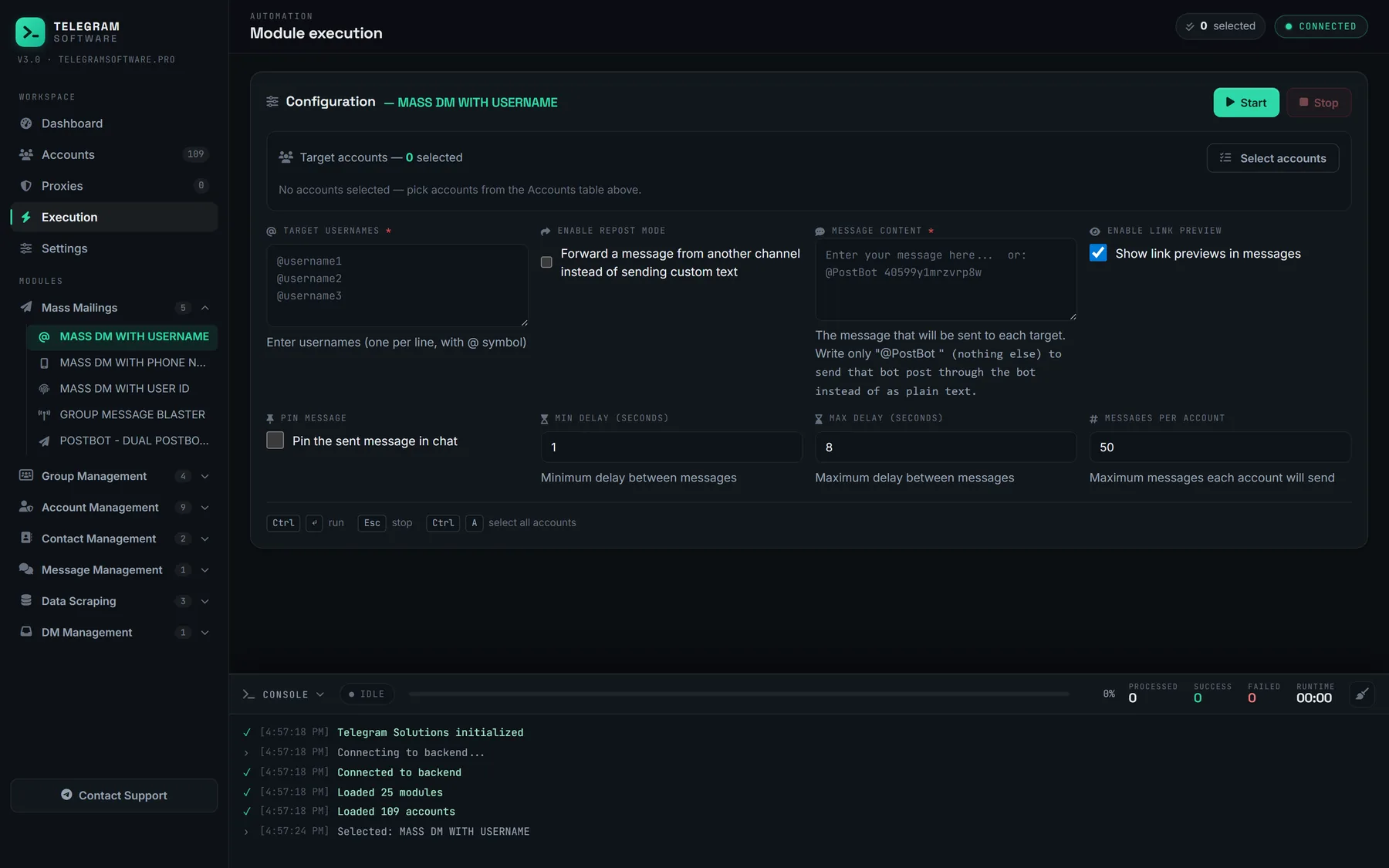
Our Mass DM — Phone Number module works that way. It imports each number into the sending session's contacts, writes to the ones that resolve, and spreads the list over the accounts you select at the Messages per account cap, pausing a random interval between Min delay and Max delay. Delete Contacts empties those address books afterwards, and each session should hold a proxy that clears Connecting before the run starts.
It cannot reach a number whose owner hides it, cannot pass a Premium or Stars gate without meeting it, raises no Telegram limit and supplies no accounts or proxies. The recipient decides the rest: a first message from someone they have not saved arrives under a bar offering Report Spam, Add contact and Block, and since March 2025 beside a card showing the sender's number country and the month they joined. Unsolicited bulk messages are exactly what people report, PEER_FLOOD is how Telegram stops an account sending them, and the spam FAQ says a limited account can then message only people who have its number saved. A phone list is personal data, and messaging it is direct marketing under GDPR, CAN-SPAM and their equivalents, so the lawful basis has to be yours, as does keeping to Telegram's Terms of Service.