Overview / Blog / Proxy settings
Infrastructure  ·  16 Sep 2026  ·  4 min read

What a Telegram proxy needs, and what its owner can see

Telegram proxy settings sit under Data and Storage on a phone and under Advanced in Telegram Desktop, and every proxy needs four of them: its kind, a server, a port, and either an optional username and password for SOCKS5 or a secret for MTProto. Connecting to proxy means no Telegram server has answered through it yet: a field does not match what the server runs, or your network cannot reach it.

The questions get typed a dozen ways — telegram proxy not working, telegram connecting to proxy, telegram socks5 proxy not working, is telegram proxy safe, how to use proxy in telegram, telegram proxy for pc — and they reduce to two: whether the fields match the server, and who sits in between.

Where are Telegram proxy settings on each app?

Under Data and Storage on a phone, under Advanced on desktop.

  1. Open Settings › Data and Storage › Proxy Settings on Android (just Proxy on an iPhone), or Settings › Advanced › Connection type in Telegram Desktop.
  2. Tap Add Proxy and pick SOCKS5 or MTProto; Desktop lists HTTP too.
  3. Enter server and port, then any SOCKS5 login or the MTProto secret.
  4. Save and read the status: Checking, then Available with a ping, or Unavailable.

A Telegram proxy link carries every field in one tap, in a format Telegram documents: t.me/proxy?server=…&port=…&secret=… or t.me/socks?server=…&port=…&user=…&pass=…. It uses the t.me scheme behind adding someone on Telegram without their number, but unlike chat invite links and join requests it joins nothing.

Telegram SOCKS5 vs MTProto: which one fits?

That depends on who the proxy serves.

A Telegram SOCKS5 proxy server is an ordinary SOCKS5 server that relays any connection. Its Telegram SOCKS5 credentials are a plain username and password, sent in cleartext under RFC 1929. Your messages stay encrypted by Telegram either way; the login does not, and neither does a t.me/socks link carrying it.

The other Telegram proxy, MTProto, speaks only Telegram's protocol. Its secret is 16 bytes in hex; an optional first byte picks the mode, dd for random padding or ee for TLS emulation with a domain appended. Anyone may run this Telegram proxy server, and its owner can pin a sponsored channel above your chats.

MTProto suits one person getting past a network that blocks Telegram. Giving each session its own SOCKS5 Telegram proxy is another job, one Telegram Desktop cannot do: its source, as of September 2026, keeps one app-wide proxy for every signed-in account.

Why does Telegram stay on Connecting to proxy?

Because Telegram has not answered through it yet.

Phones show Connecting to proxy…, Telegram Desktop shows Connecting through proxy…, and the list marks the entry Unavailable. TDLib, the client library Telegram maintains, tests a proxy by sending a request to Telegram's servers through it, and names what failed:

Error textWhat it points toWhat to change
Wrong username or passwordA SOCKS5 login the server rejectsRe-enter both exactly
Wrong proxy secretA mistyped secret, or MTProto details in a SOCKS5 entryAdd it as MTProto, prefix intact
Connection timeout expiredNo answer at that address, or a network dropping itCheck the port, then another network

A reply like USERNAME_NOT_OCCUPIED is the opposite case: the request reached Telegram, so what a username not found reply actually means is a question about the name, never the proxy.

Can a proxy's owner read your messages?

No, but they can see your address.

Telegram's proxy documentation says an MTProto proxy's owner cannot read your messages or see the user ID behind your account but can log your IP address and when you connect, and the Desktop and Android apps warn about exactly that. No proxy changes whether your number turns up in a phone number search, either. Settings › Devices shows the last IP address Telegram saw per session, the list where ending an old phone's session stops deleted contacts coming back after a sync.

One proxy per session, and what it never changes

A pool turns the use of proxy in Telegram into an inventory. In our panel the Proxies view takes one entry per line, Protocol accepts SOCKS5, SOCKS4 or HTTP but not MTProto secrets, and Sharing on One proxy per account gives each session the least-used entry. Auto-assign before a module runs fills accounts that have none, and a run stops rather than connect an account left without a working one. Whether proxies bind per session is one of the pre-purchase checks for Telegram marketing tools.
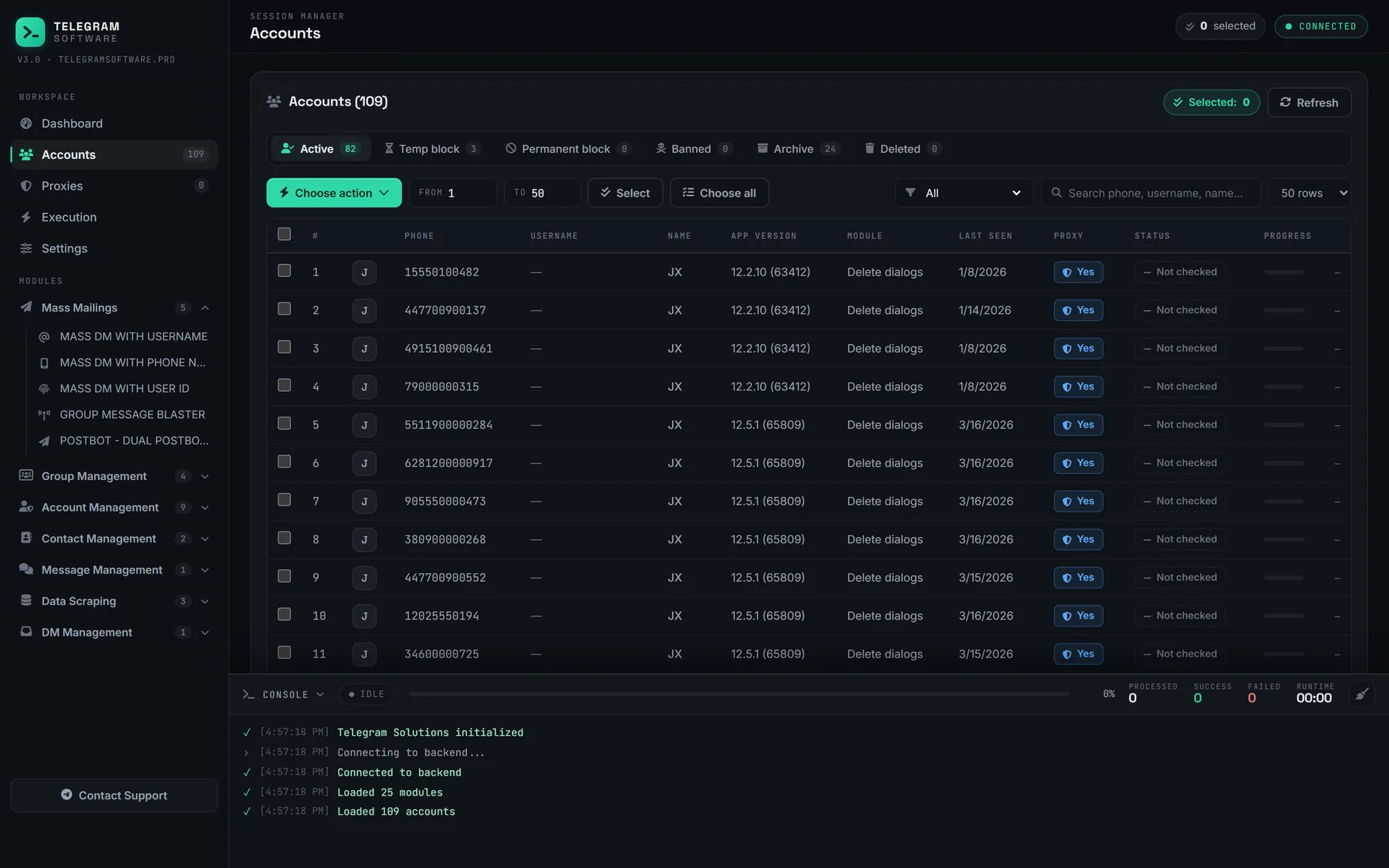
A proxy column marked Yes for every session, which is how a socks5 telegram proxy pool shows up in the account list

Each session holds its connection open through a run, which is also why an auto forwarder needs an always-on machine. None of that reaches the account itself: the joined-chat cap behind the errors a group blaster hits while joining counts its chats, the add errors that no waiting clears are other people's settings and fixed caps, the three ceilings on a bulk member run stay put, and Telegram's spam FAQ places limits on accounts.
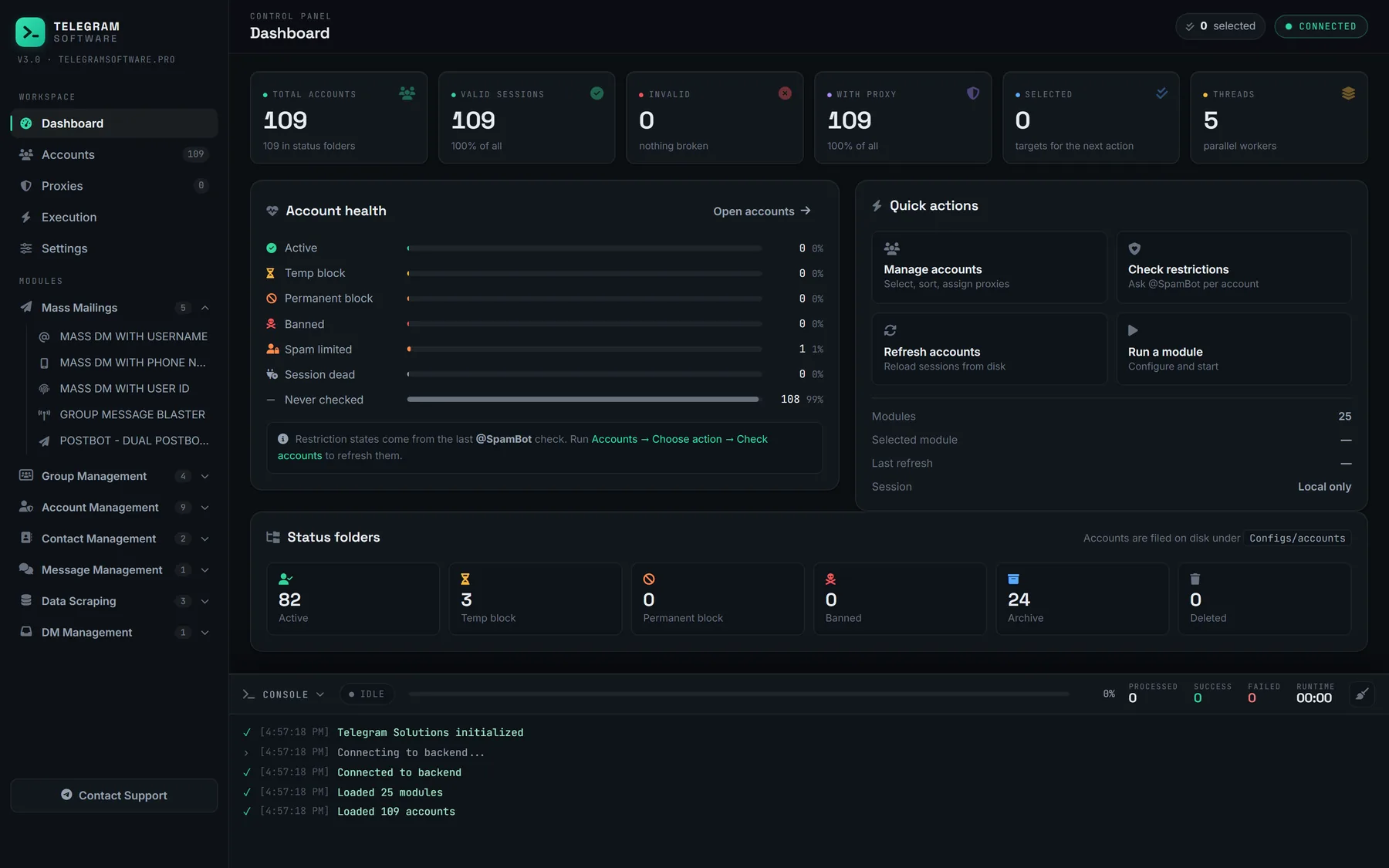
With proxy reads 100% on the dashboard while account health still counts a spam limit, because a proxy changes only the route

Telegram's Terms of Service never mention proxies. We sell no proxies, and no proxy makes an account undetectable.

Questions

Proxies, secrets and who sits in the middle

Is a Telegram proxy safe to use?
For your messages, yes; for your IP address, no. Telegram's proxy documentation says the owner of an MTProto proxy cannot read your messages or identify your account, but can record your IP address, when you connect and the fact that you use Telegram, and the Desktop and Android apps warn about that exposure when a proxy is added. Cloud chats are encrypted between your app and Telegram's servers, so a SOCKS5 relay carries the same encrypted traffic; only Secret Chats add end-to-end encryption on top. The risks sit around the relay rather than inside it: a SOCKS5 login travels in cleartext, a shared t.me/socks link contains the password, and an MTProto owner can pin a sponsored channel. So the honest answer to is telegram proxy safe is a question of trust in whoever runs it. Connect only through a proxy whose operator you would trust with your address.
What are Telegram SOCKS5 credentials, and does every proxy need them?
No, only a SOCKS5 server set up to ask for a login needs them. Telegram SOCKS5 credentials are a username and password issued by whoever runs the socks5 telegram proxy, and the app sends them to the proxy before any Telegram traffic moves through it. Both fields are optional in the app, so a server that takes connections without a login simply leaves them blank. A server that expects one rejects a blank or mistyped pair, which TDLib reports as Wrong username or password. RFC 1929, the standard for this login, sends the password in cleartext, so never reuse a password that protects anything else, and treat a t.me/socks link as a copy of the login, because user and pass sit inside the link. MTProto proxies have no username or password at all, since the secret does that job. Copy credentials exactly as issued, capital letters included.
How do you add a proxy from a Telegram proxy link?
Open the link on a device where Telegram is installed and let the app read it. A Telegram proxy link is a t.me/proxy address carrying a server, a port and a secret for MTProto, or a t.me/socks address carrying a server, a port and an optional username and password for SOCKS5, and the tg://proxy and tg://socks forms carry the same fields. Telegram takes the details from the link, so nothing needs typing, and the proxy then sits in the same list as one added by hand, with the same Checking, Available or Unavailable status. That is how to use proxy in telegram when someone hands you a link instead of a server address. Because the link holds everything needed to connect, a SOCKS5 password included, share it only with people you would give that login to. If Telegram Desktop reports that the proxy link is invalid, check that nothing was cut off when it was copied.
Which proxy types does Telegram for PC support?
More than the phone apps do. Telegram Desktop, the app for Windows, macOS and Linux, offers MTProto, SOCKS5 and HTTP in its telegram proxy settings under Settings, Advanced, Connection type, plus a newer WEB type that Telegram's developer documentation does not describe, while Android and iPhone offer SOCKS5 and MTProto only. The same desktop screen holds Use system proxy settings and Auto-switch proxies. Two details matter when you choose a telegram proxy for pc. Voice and video calls in Telegram Desktop do not go through the proxy, because the app's code marks proxies as unsupported for calls. And the proxy is stored as an app-wide setting rather than per account, so every account signed in to one copy of Telegram Desktop shares the same one. When several accounts on one computer each need a separate proxy, a single copy of the desktop app cannot give them that, whatever you enter in its settings.
Why is a SOCKS5 proxy not working in Telegram when the details look right?
Because a proxy only counts as working when Telegram's servers answer through it. A server that works for a browser can still fail that test, since reaching a website proves nothing about reaching Telegram. Check four things in order. The type: a SOCKS4 or HTTP proxy saved as SOCKS5 cannot complete the handshake. The login: a server that expects credentials refuses a blank pair, which TDLib reports as Wrong username or password. The route: a network that blocks the port produces Connection timeout expired, so try the same entry on another connection. The server: some SOCKS5 services accept clients only from IP addresses registered with them in advance. When a telegram socks5 proxy not working passes all four checks, the server itself is refusing traffic to Telegram, and only whoever runs it can change that. Ask them before you replace anything on your own side.
Can you run your own Telegram proxy server?
Yes, and Telegram's documentation invites it. Telegram publishes the source code of MTProxy, its own MTProto proxy server, with setup instructions: generate a random 16-byte secret, start the server, and share the resulting t.me/proxy link. Registering the proxy with @MTProxybot gives it a tag, and that tag is what lets its owner attach a sponsored channel for the people who connect. A telegram socks5 proxy server, by contrast, is not specific to Telegram at all: standard SOCKS5 server software works, and you decide whether it asks for a username and password. Running either one makes you the party that can see your users' IP addresses and connection times, so the trust question now points at you. Host it with a provider whose terms allow proxy traffic, keep the secret and any login private, and share links only with the people meant to use them.
Why does an MTProto proxy show a channel you never joined?
Because the proxy's owner registered it with Telegram and attached a sponsored channel. Telegram's API documentation describes the sponsoring channel being pinned at the top of the chat list for anyone connected through that proxy, where the apps label it Proxy sponsor. It is not a subscription and the account joined nothing; the channel appears because of the connection, and it is a feature of the telegram proxy mtproto type only. The official apps point to one way of removing it, which is to disable the proxy, and the pinned channel leaves with it. SOCKS5 proxies have no such mechanism, which makes it one practical difference in telegram socks5 vs mtproto beyond credentials and secrets. Treat a sponsored channel the way you would any advertiser that also sits on your connection and knows your IP address, and switch to a different proxy if that trade does not suit you.
Does switching proxy lift a flood wait or a spam limit?
Nothing Telegram documents says it does. FLOOD_WAIT_X is Telegram telling a client to wait X seconds before repeating a call, and its error documentation does not tie that wait to an IP address, while its spam FAQ describes limits placed on accounts after reports without mentioning addresses at all. So treat the use of proxy in telegram as a routing choice rather than a reset. Honour a flood wait in full, and if an account is limited, ask @SpamBot about its status, which is where Telegram explains what the limit covers. What a separate proxy per session does change is containment: one relay failing takes one account offline instead of every account behind it. It changes nothing about what those accounts are allowed to send, and no software raises Telegram's limits, so fix the sending pattern that earned the wait before touching the network.

A proxy for every session, checked before the run

Telegram Solutions hands each selected account its own proxy from the list you paste, and stops a run rather than connect an account left without one.