Does a Telegram mass report bot actually change anything?
It files reports. Nothing past that is in its gift.
Start with the word bot, because it is doing marketing work rather than technical work. The Bot API has no report method — not for a channel, not for a user, not for a message — and every reporting method in the MTProto layer carries the same line in Telegram's own reference: only users can use this method. A telegram report bot advertised as filing complaints on your behalf is therefore not running on a bot token at all. It holds logged-in sessions and speaks the protocol Telegram Desktop speaks, which means every report leaves from an account somebody had to register, warm and keep alive.
That single distinction decides who carries the consequences. Not the software. The accounts.
Three report endpoints, and they are not interchangeable
Most write-ups in this category name one method and stop there. The API offers three. They reach different places, and choosing wrong is the commonest reason a run finishes clean while nothing moves.
account.reportPeer reports the peer itself, meaning an account, a channel or a group, and it takes a reason from a fixed list: spam, violence, pornography, child abuse, copyright, fake, illegal drugs, personal details, an irrelevant geogroup, or other. It answers with a plain boolean.
messages.report reports specific messages inside a peer, and it has changed shape since most of the public scripts were written. It no longer accepts a reason constant. It takes an opaque option identifier from a menu Telegram's server hands back, and returns a result that is itself a conversation — choose an option, add a comment, or reported. A telegram mass report script built against the old signature does not throw a loud error when that happens. It just stops matching the API it targets.
channels.reportSpam is the one nobody advertises, because it requires administrator rights in the supergroup. It is a housekeeping tool for people already running a group, not a way in from outside, and in the apps it is the spam box an admin can tick beside the option that deletes every message one member sent.
| What you are reporting | The method underneath | What comes back |
|---|---|---|
| A channel, group or account | account.reportPeer, with a reason constant | A boolean — the request was accepted |
| Specific messages in a peer | messages.report, with a server-supplied option | Choose an option, add a comment, or reported |
| A member of your own supergroup | channels.reportSpam | A boolean, and only if you are an admin |
Read that last column again, because it is the honest part of the whole subject. A boolean means the request was accepted. The reported result means the report was sent successfully and nothing further is required of you. Neither one says a moderator agreed with it.
Where a report goes once it leaves your client
It joins a queue nobody outside Telegram can see.
The spam FAQ describes the path in one sentence worth reading slowly: when users press the report button the messages go to a team of moderators for review, and if the moderators decide that the messages deserved this, the account becomes limited temporarily. That conditional is the entire design. A report is an input to a human decision, not a trigger on a counter. A telegram mass report bot changes the number of inputs. It does not touch the decision.
One boundary underneath all of this goes unmentioned by the panels. Private groups and chats, Telegram says in its general FAQ, are private amongst their participants, and it does not process any requests related to them. Reporting a private group is not a slow route to an outcome. It is a closed one. Public channels, bots, groups and sticker sets are the surface moderation actually covers, which is why a telegram channel mass report is at least pointed at something reviewable.
The report is evidence handed to a reviewer. Nobody on your side of the API gets to be the reviewer.
How many reports does it take to ban a Telegram channel?
There is no number.
Not a secret one either. Telegram publishes no threshold, no weighting rule and no mapping from report count to outcome anywhere, and the two places it does describe moderation both point the other way: reports are checked by human moderators, and restrictions of consequence need a person to approve them. Every figure circulating in this category — fifty reports for a limit, five hundred for a channel, a success percentage printed beside a price — is vendor-asserted rather than measured. We publish no figure either. The decision happens on servers we do not run.
The cost runs in the other direction, and that part is documented. Under Telegram's terms for the EU Digital Services Act, processing can be suspended for anyone who repeatedly submits manifestly unfounded, fraudulent or misleading reports. A campaign built on reasons that do not match the content spends the standing of every account that files, before anyone reviews the first one. Those accounts are also just accounts, collecting flood waits like any other session and climbing the same ladder of restrictions a bulk sending run climbs.
Telegram mass report panel, script or service — the same three parts
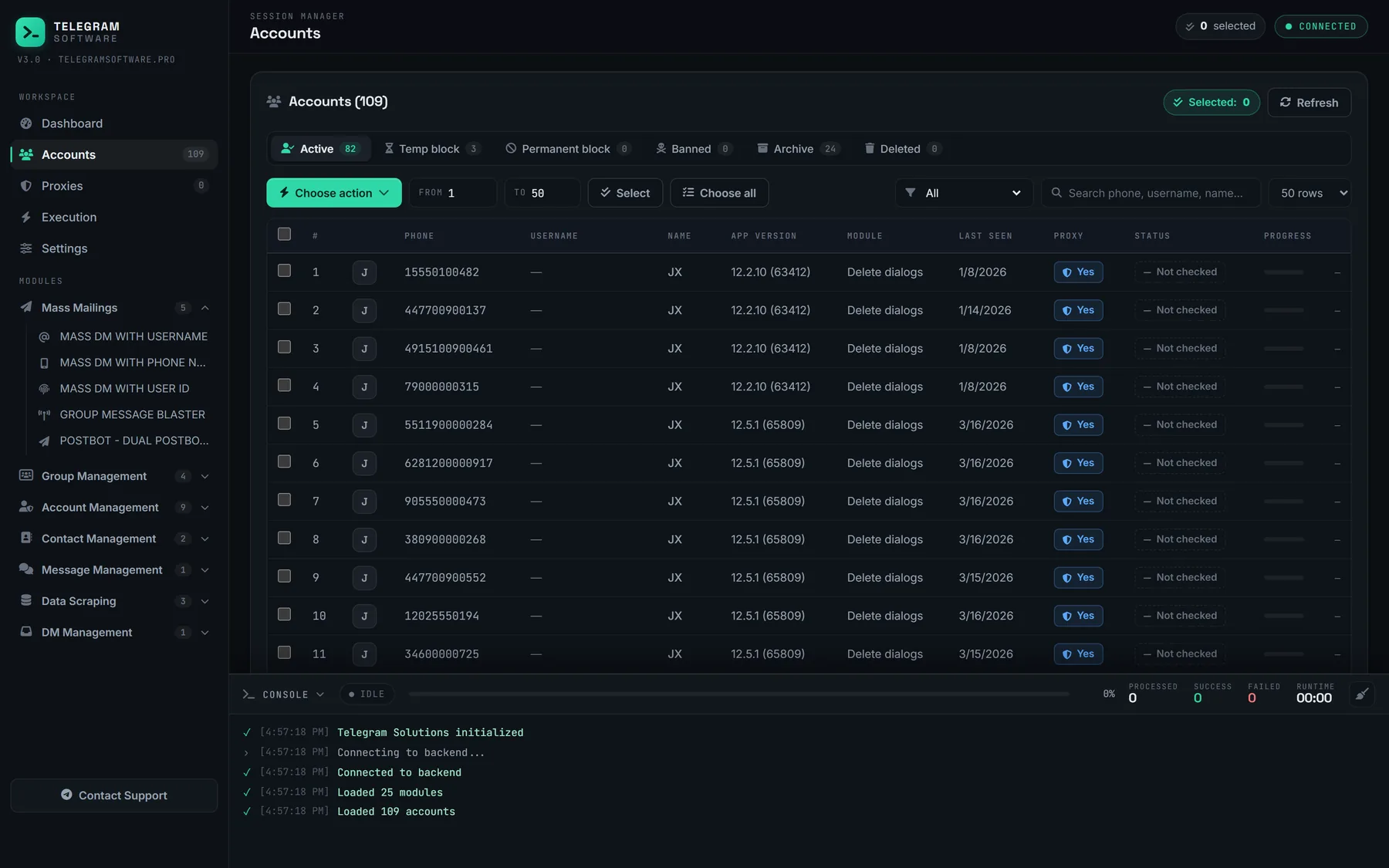
Strip the branding and the whole category reduces to three components: accounts, a proxy for each account, and code that calls one of the three methods above.
You will meet it under a dozen names — a telegram mass report bot, a telegram mass report panel, a telegram mass report script, a telegram mass report service, or plainly a telegram mass reporter — and the pitch never varies: paste a link, pick a reason, watch it vanish. What differs between the tiers is not capability, because the API call at the bottom is identical in all of them. The difference is who holds the sessions when it goes wrong.
A public repository is the honest version of the arrangement. You supply the accounts, you supply the proxies, you carry every consequence, and you find out on the day the signature moves that nobody has merged a pull request since 2023. A telegram mass reporting service inverts it: somebody else's accounts file, which sounds like insulation until you ask what those accounts did last week, and whether yours joins the pool afterwards. Panels mostly resell the middle. Anything sold as telegram mass reporting software is the same three parts with an installer.
- Accounts registered, warmed and still usable
- One proxy per session, since a hundred sessions on one address is one session
- Somebody maintaining the code against an API layer that moves
None of the three is exotic and none of it is free, which is why every telegram mass report tool in the category produces identical API calls at very different reliability. Where the target list itself came from is a separate question with its own failure modes, and what a group export can and cannot contain decides more of a run than the tooling does.
What does the Mass Reporter module do, and what will it not do?
It builds the same call, across a pool, with the reasons written down where you can check them.
Mass Reporter — Advanced opens on one configuration screen. Report type chooses the shape of the call: a channel, group or bot; a specific message link; a profile photo; or a direct complaint to bot support. Targets takes one entry per line as a username, a channel handle or a t.me link, and a message link when you picked the message type. Report reason is that fixed list again, with two optional slots beside it so one filing can carry a primary reason and two supporting ones. Report message is free text, and it is the field that does the most work, because a moderator reading a specific sentence about a specific post has been handed evidence rather than a category.
Target distribution spreads the target list across the selected accounts. Delay between targets and the concurrency limit pace the run on the same engine every other module in the Account Management group of the catalogue uses, so a wait against one session stands that session down without stopping the pool. The console then prints what each account did: connected, reporting, reported, and a closing line reading three sent, zero failed.
Read that line carefully. Sent is not actioned.
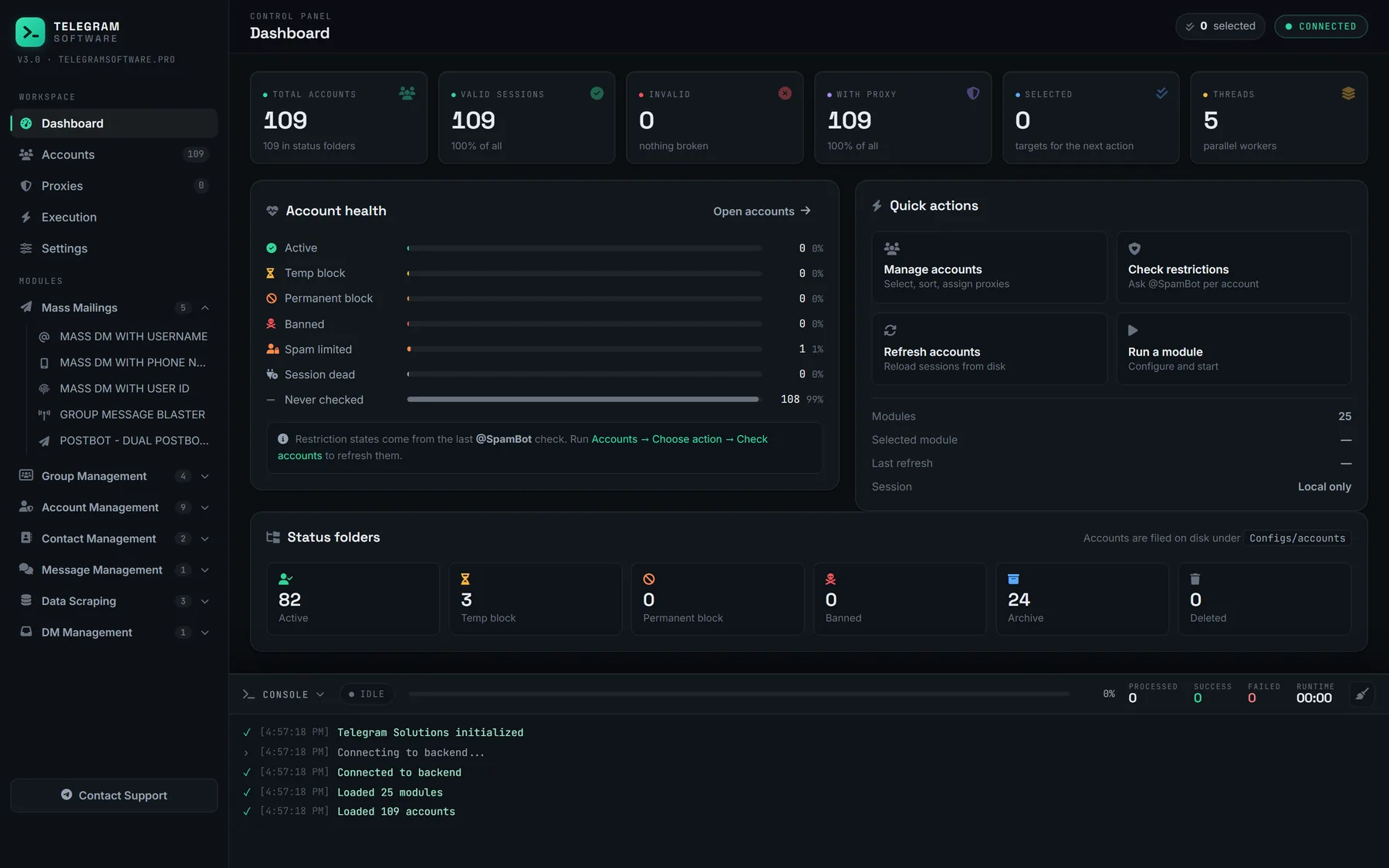
Here is the part that will not appear on a sales page. This software does not decide outcomes, cannot see a moderation queue and cannot tell you whether a report was ever read. It does not lift or route around any Telegram limit, because those live on Telegram's servers and bind every client equally, ours included. It does not supply accounts or proxies; you bring both. And it is no help with a report that is not true: filing a reason that does not match the content is a Terms of Service problem before it is a tactical one, since the agreement asks you not to spam or scam other users.
If the reason is real, a telegram mass report tool is a scheduler with a log. If it is not, it is a way to lose accounts at scale.
The reporting module ships with the other twenty-four rather than separately, so what access to the whole suite costs is one number rather than a per-report price. If a case might not be in scope at all, tell us what you are looking at first, and the other module walkthroughs here take the neighbouring screens apart the same way.