Most guides to cold outreach were written for Instagram, LinkedIn or X, and they treat the inbox as neutral ground. Telegram is not neutral. Every first message from a stranger is framed by the app as a possible spam case, the recipient can stop strangers writing at all, and the penalty for an unwelcome message falls on the sending account within days. So the craft of the message and the mechanics of sending it cannot be separated here.
This article covers both halves: what a cold DM and a mass DM are, the platform rules they run into, how to write a cold DM script that earns a reply, how a DM campaign is put together, and where DM automation tools help and where they do not.
What is a cold DM, and how is it different from a mass DM?
What is cold DM, in one line: a direct message to someone with no prior relationship, sent to start one. It is the chat-app version of a cold call. The person did not opt in, does not know the sender, and owes nothing. A cold DM can be one carefully researched note to a single founder, and that is still a cold DM.
What is mass DM, then? Mass DM meaning the same first message, or close variants of it, sent to many people in one run, usually by software. A bulk DM is the same thing under another name, and a bulk DM sender or mass DM sender is the tool that does it. The difference is scale and attention. A single cold DM can be written for its reader. A mass DM almost never is, and recipients can tell, which is why the report rate behind mass sending is so much higher than behind a handful of personal notes.
Most real cold DM outreach sits between the two: a list of a few hundred people who share something, one cold DM template with a line or two changed per person, and a send spread over days. That middle ground is where Telegram's rules bite hardest.
Why Telegram is a different inbox
On Instagram a message from a stranger usually waits in a requests folder. On Telegram it opens as a normal chat, but the app adds an action bar with options to report spam, block, or add the sender to contacts. Telegram documents this bar in its action bar reference, and it shows on chats with people not in the user's contacts. One tap there is a spam report against your account.
Recipients can also close the door before you knock. Since January 2024, Premium users can accept new chats only from contacts and other Premium users, and since March 2025 they can set a fee in Stars for messages from anyone outside their contacts. A cold DM to such a user either fails with an error or costs Stars to deliver. Your own sending accounts have settings too, and the privacy settings on the accounts you send from decide what a curious recipient sees when they tap your name.
The Telegram rules a cold DM runs into
Telegram's Terms of Service say users agree not to use the service to send spam or scam users. Its spam FAQ explains how that is enforced: moderators review spam reports, and the sending account can be limited for a while. The FAQ is explicit that the content hardly matters; what counts is whether the receivers found the message unwelcome. A limited account can only message people who have its number saved. It can still reply to anyone who writes first. A first limit typically lasts a few days, and repeat offences bring longer ones.
Those two pages are the whole public rulebook. Telegram publishes no number of cold DMs per day that counts as safe, and figures such as twenty or fifty new chats a day for an aged account are observations from vendors and forums, not policy. What the rules do say is that the reaction of the people you write to decides what happens to the account. A slow send of an unwanted message still gets reported.
What the sending account sees
From a script or a desktop tool, the rules arrive as errors. The messages.sendMessage reference lists PRIVACY_PREMIUM_REQUIRED for a recipient who only accepts Premium senders, ALLOW_PAYMENT_REQUIRED for one who charges Stars, and USER_IS_BLOCKED for one who blocked you. Libraries add their own names, such as a privacy-restricted error when settings refuse you; in every case, skip that person. FLOOD_WAIT with a number of seconds means the account called a method too fast and must pause. PEER_FLOOD, which Telegram does not define in its public error list, appears when an account writing to strangers has already been limited. Once that appears, the honest next step is asking @SpamBot whether the account is limited and stopping first messages from it until the date it gives.
Finding people is governed by rules too. How global username search decides who appears matters if your list is built from usernames, because a username that search cannot find is often one the owner set up to stay out of reach. Treat that as a signal, not a puzzle to solve.
How do you write a cold DM someone answers?
How to cold DM well, or how to do cold DM at all on this app, is mostly about removing reasons to report. The best cold DM strategy on Telegram is short, specific and easy to decline. The recipient should know within two lines who you are, why them, and what you want, and they should be able to say no without effort. A message that hides its purpose until the third reply reads as a scam opener, because many scams open exactly that way.
Alex Hormozi's framework in $100M Leads is the one people mean by cold DM alex hormozi. His "core four" puts cold outreach beside warm outreach, free content and paid ads: one-to-one contact with strangers, harder per message but with a far larger pool. Summaries of the book credit him with researching each lead, personalising the message and following up two or three times before moving on. That holds on Telegram, with one adjustment: the personal part has to be in the message itself, because nobody here clicks a link from a stranger to find it, and a third follow-up to someone who never answered is the message most likely to be reported.
Here is the best cold DM template we know for Telegram, as a five-part cold DM outreach script:
- Context first. Name the shared group, channel or post that led you to them. "Saw your answer about payment bots in the builders group" beats any greeting.
- Who you are, in one clause. Your role and project, without adjectives.
- The specific reason for them. One fact about their work that makes this message theirs and not a copy.
- A small, concrete ask. A yes-or-no question, not a call. "Would a two-line summary of how we did it be useful?"
- An easy exit. "If not, no reply needed." It costs nothing and lowers the urge to report.
The best cold DM openers follow the first step. "Hey, quick question" and "Hope you're well" are the openers most often reported, because they carry no context and every spam chain uses them.
Cold DM examples and scripts that fit Telegram
Three cold DM examples built on that script, each short enough to read in a preview. For a developer: "Saw your bot repo linked in the TDLib group. I run a small analytics project and we hit the same webhook bug you fixed. Would you take a paid hour to look at ours? If not, all good." For a channel owner: "Your channel's weekly roundup is how I found two of our users. We'd pay for a mention in the next one. Want our rate card, or not your thing?" For a community admin: "Your group's rules ban promos, so asking here first: could we run one pinned AMA? Happy to take a no."
None of them is the best cold DM script for every case, and that is the point. A cold DM script that works is one with the specific line filled in by hand. Anything you send to a few hundred people unchanged is a mass DM wearing a cold DM's clothes.
What does a DM campaign need before the first message?
A DM campaign is a planned set of cold DMs to one defined audience, with a message, a schedule and a way to track replies. DM campaigns fail more often on preparation than on wording. Before anything is sent, a DM campaign builder, whether it is software or a spreadsheet, has to answer four questions: who is on the list, which accounts send, what each account says, and where replies go.
The list comes first. If it is phone numbers, checking which numbers on a list have Telegram removes dead targets before they cost anything, and importing a list into contacts in bulk is how a number becomes someone you can message at all. If it is usernames, they usually come from groups your audience already sits in, which means joining a long list of groups first, with its own limits.
The accounts come next. A fresh number writing to strangers on its first day is the profile spam reports land on fastest, so a warm-up period of normal use for each new number comes before any campaign. Teams running several accounts keep them in one session manager for many accounts, and moving an account between tools may mean converting a session file into TDATA for Telegram Desktop. A recognisable sender helps too. Claiming a clean username for each sender lets recipients see a name that matches your brand instead of a random handle.
A DM campaign template and notebook
A useful DM campaign template has one row per target: source, the personal line, sending account, date sent, reply, outcome. Searches for a DM campaign notebook mostly turn up notebooks for tabletop game masters, the other kind of DM, but the idea transfers. A DM campaign manager, human or software, should be able to tell you on any day which accounts sent what, to whom, and which of them got reported. DM campaign tools that cannot show that are only senders.
DM automation tools: what they automate and what stays manual
DM automation means software sends the messages, paces them and logs the result while you write the message and choose the audience. A DM automation tool on Telegram works in one of two ways, and the difference decides what it can do. Bot-based tools use the Bot API, and Telegram's bot introduction is plain that bots cannot start conversations: a user has to message the bot or add it to a group first. That is why a bot cannot mass DM strangers, whatever an auto DM bot listing promises. Even pressing Start on a referral bot from many accounts is the user acting, not the bot.
So every Telegram mass DM tool that reaches people who never wrote first runs on user accounts, through the same client protocol the official apps use. That is also the honest answer to how to make a mass DM bot: you do not make a bot, you script user accounts with a library such as Telethon, and you inherit every limit above. How to mass DM, technically, is a loop of send, wait and log. The hard part is everything this article has covered before this section.
Telegram Solutions is a Windows desktop panel that runs the accounts you bring. Its three Mass DM modules take targets by username, phone number or user ID, send the message body you write, and let you set a minimum and maximum delay between messages and a cap on messages per account. The screen below shows that configuration. In the source we reviewed, the module skips recipients whose privacy settings refuse the message and stops an account at its first PEER_FLOOD rather than moving to the next name.
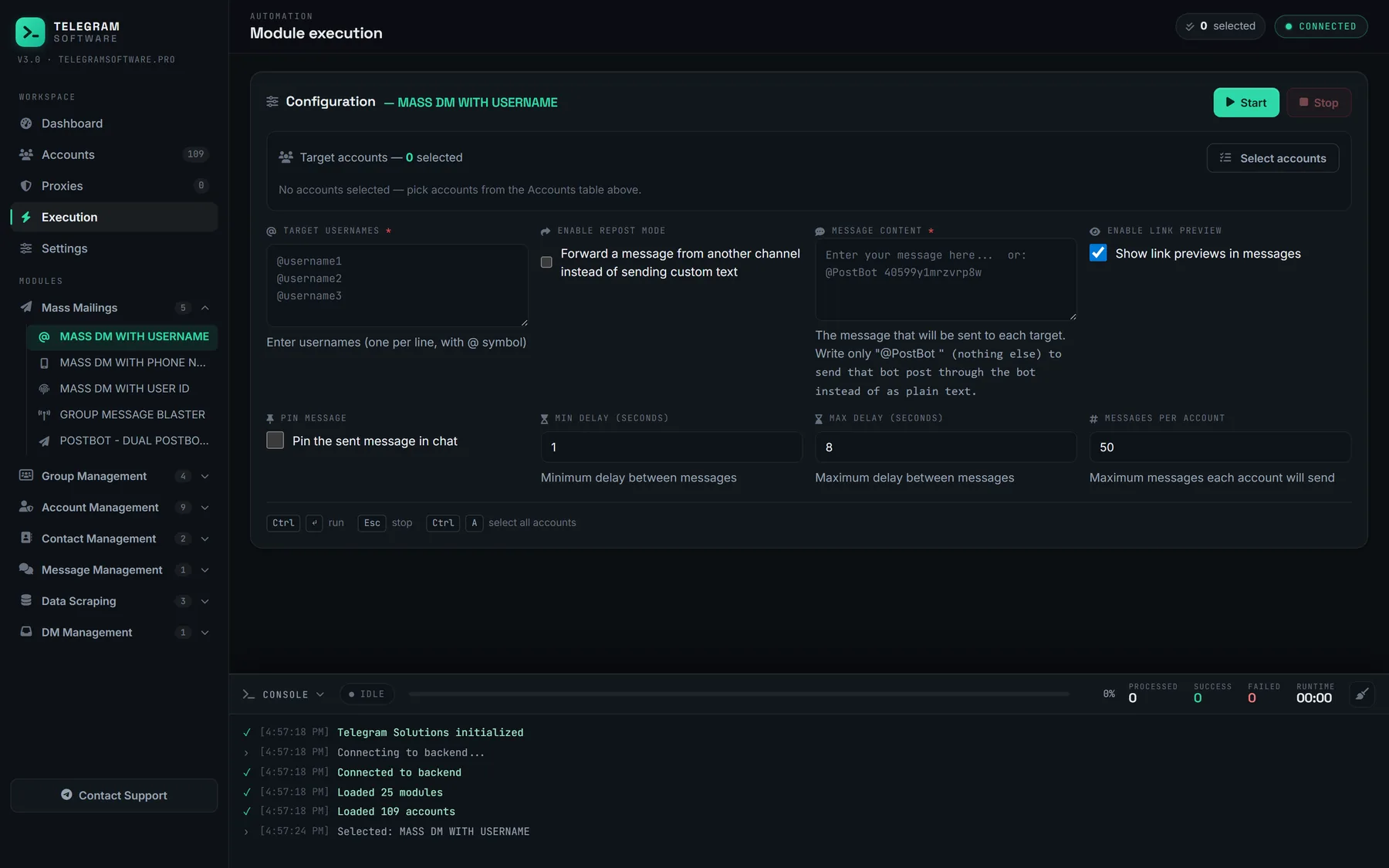
The walkthrough below shows a run from start to finish, including where the targets and the message go.
The wider DM automation app around the send
Sending is one module of many. What Telegram software tools actually automate covers the rest of the list. Two parts matter for a campaign. Rich messages with buttons go out by sending a PostBot code from an account. Replies arriving across a dozen accounts are worthless if nobody reads them, and one inbox for every account's DMs is where a cold DM turns into a conversation. Posting in groups is a separate job from DMs, and dripping posts into groups over time has its own rules.
On cost: there is no free DM automation tool for Telegram that sends from many user accounts without trade-offs. Searches for DM automation free, a free auto DM tool or a free auto DM automation tool mostly lead to open-source scripts you run and maintain yourself, or to bot builders that cannot write first. An auto DM tool or DM automation app that charges is selling the panel and the time saved, not delivery. A mass DM service, and most mass DM services sold by the thousand messages, sends from accounts you do not control, so the reports land on someone else's numbers and you see none of the replies.
When should you not send a cold DM at all?
When the person has no reason to recognise why they are hearing from you. If your list came from a scrape of a large group and you cannot write one true sentence about each person, the message is spam by Telegram's definition, however polite it is. The same goes for anyone whose profile says no DMs, any group whose rules forbid contacting members, and any offer you would not mention in public.
No software lifts Telegram's limits, and none makes an account immune to reports. The DM strategies that last on Telegram are the ones with a small, relevant list, a message written for it, and replies handled by a person. A DM outreach strategy built around volume trades a few weeks of sends for a stack of limited accounts. DM outreach that starts warm, from a group you actually take part in or a post the person wrote, is the version Telegram's own rules leave room for.